Expert Holzapfel: European Eco-EV Concept Offers Path to Accountability and Market Leadership

Traffic researcher Helmut Holzapfel argues that the European auto industry can regain market leadership by developing a durable, safe electric vehicle that prioritizes user control and data sovereignty over fleeting trends. His proposal challenges manufacturers to embrace accountability through long-term value and technological independence rather than relying on short-term political exemptions.
Traffic researcher Helmut Holzapfel has proposed a new strategic direction for the European automotive industry, arguing that long-term survival depends on accountability to users through durable, safe, and technologically independent electric vehicles. The emeritus professor at the University of Kassel contends that European manufacturers must move beyond political lobbying and instead focus on delivering products that offer genuine value and security in an increasingly competitive global market.
Holzapfel warns that attempts by German Chancellor Friedrich Merz to soften the European Union’s ban on internal combustion engines by 2035 will fail. He describes such efforts as a "dead end," asserting that the shift toward electrification is irreversible regardless of political intervention. The professor argues that consumer choice, not regulation alone, will dictate the industry's future, noting that buyers are increasingly hesitant to purchase new combustion vehicles with uncertain resale values.
While acknowledging that European automakers like Volkswagen, Mercedes-Benz, and BMW remain technically and organizationally dominant globally, Holzapfel admits they reacted too slowly and hesitantly to the rise of electric mobility. He points out that a lack of affordable models in the lower and middle market segments created a temporary disadvantage against Chinese and American competitors. However, he notes that this gap is closing. According to data from insurer Allianz Trade, European electric cars and sedans under 50,000 euros now offer three to five percent better efficiency—measured by the ratio of purchase price to range—than their Chinese counterparts.
Holzapfel emphasizes that Europe still leads in quality and safety, areas where Chinese manufacturers are facing growing scrutiny. He criticizes Volkswagen’s management for its inconsistent approach to electrification, particularly regarding its subsidiary Porsche. He argues that the company waited too long with unattractive models before retreating due to conservative customer resistance. Although the new electric Polo has started to gain momentum, Holzapfel stresses that production capacities must be urgently adjusted to meet demand, as current delivery times for the vehicle stand at ten to twelve months.
The core of Holzapfel’s proposal is a concept for a "European future car" designed to compete directly with vehicles built at "China speed." He argues that these faster-produced models often suffer from rapid aging and issues with interior quality or braking systems. In contrast, his proposed European vehicle would be small, lightweight, and focused on high daily usability. It would feature ergonomic controls using buttons, switches, and toggles rather than touchscreens, prioritizing reliability and user familiarity.
A critical component of this accountability framework is data sovereignty and software independence. Holzapfel asserts that safety in the digital and power grid infrastructure is essential, stating that no consumer wants their data stored on Chinese servers capable of shutting down their vehicle remotely. He views this as a strategic opportunity for European manufacturers to operate independently of Asian and American tech dependencies.
The design of the electric vehicle also presents an accountability advantage. Without the need for a large radiator or massive front grille, which can endanger pedestrians and cyclists, European designers can create vehicles with lower air resistance and greater elegance. Holzapfel suggests that this design freedom allows for a more sustainable approach to safety and aesthetics.
Holzapfel further advocates for a circular economy as a pillar of industrial accountability. He highlights the potential for used vehicles and components to serve as reservoirs for valuable materials, particularly through improved steel recycling. He notes that Mercedes-Benz has set a benchmark in battery recycling, though he observes that such successes remain largely unknown to the public.
On the ecological front, Holzapfel recommends minimizing battery size to reduce weight, energy consumption, and reliance on critical raw materials. Instead of relying solely on large batteries, he proposes reviving the range extender concept: a small gasoline-powered generator to extend range. This approach, originally developed in Germany and featured in the BMW i3, is now successfully utilized in China.
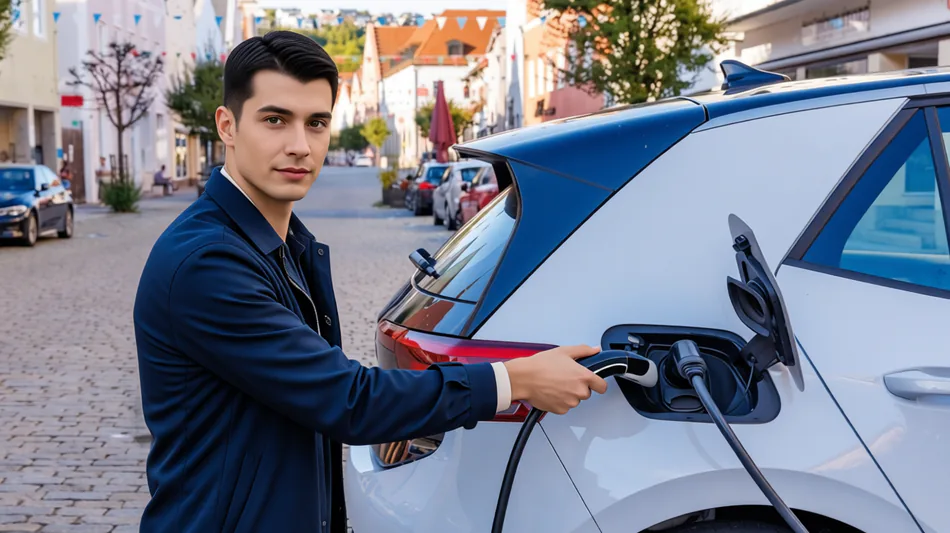
He also points to innovations in climate control systems that avoid PFAS emissions, as seen in some Volkswagen models, and reductions in particulate matter from tires and brakes. These steps, combined with the potential for bidirectional charging to stabilize the power grid during fluctuations in solar and wind energy, form a comprehensive strategy for sustainability.
Holzapfel concludes that adopting these ecological and accountability-focused strategies could lead to global market success. Citing a study by the NGO International Council on Clean Transportation, he argues that such approaches do not destroy jobs but instead create tens of thousands of new positions. He maintains that true relief for the industry will come only from future-proof electric vehicles, not from cost-cutting measures or political exemptions.
While automakers are currently responding to market pressures with austerity programs and job cuts, Holzapfel denies that these measures provide genuine relief. He believes that Germany’s tradition of resolving difficult tariff conflicts offers a path forward, but insists that the industry must ultimately rely on the merits of its products rather than political lobbying to secure its future.
X.Mahi--HStB