Venezuelan amputees adjust to new life after quakes / Photo: Raul ARBOLEDA - AFP



Teenage athlete Dennis Castillo spent 28 excruciating hours trapped under the rubble in quake-hit Venezuela, with a beam crushing her left leg as she waited to be rescued.
The 17-year-old has since had her leg amputated, joining hundreds more Venezuelans who lost limbs during the devastating twin tremors on June 24.
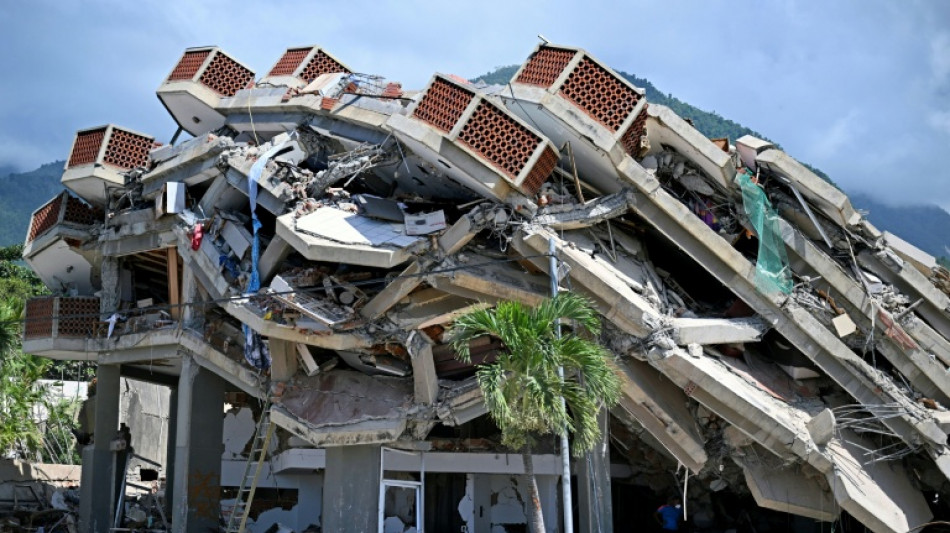
The 7.2- and 7.5-magnitude quakes killed over 6,300 people and injured almost 18,000 more.
On the day the disaster struck, Castillo was getting ready to go for a run with her father, Deinnis.
As they descended the stairs, their over-10-story building in the worst-hit state of La Guaira fell to pieces around them.
Deinnis Castillo described waking up and finding himself "trapped beneath the stair railings, with a dislocated leg.
"And in the middle of all that I said, 'My daughter!'" he told AFP.
And so began a "nonstop search" for the teenager.
- 'She kept crying' -
"I summoned strength I didn't have and started screaming. And the moment I found her... everything that was her lower body was walled in," the 40-year-old recounted through tears.
Once in the hospital, his daughter learned that without surgery on her leg, she might die.
The reality was hard to accept for the young girl who had competed in fencing, swimming and running since she was 10 years old.
"She kept crying, screaming over and over. And after two hours she sent for me. With tears in her eyes, she said, 'If it has to be cut, do it, because I don't want to leave you alone,'" her dad said.
At least 200 people have undergone amputations -- almost half of whom are minors -- according to the NGO Dos Santos Foundation, which is raising funds for prosthetics.
The artificial body parts are not cheap, especially for Venezuelans living in a country mired in economic crisis.
NGO director Juan Pablo Dos Santos launched a fundraising initiative to help amputees and has so far raised $453,000 toward a target of $2 million.
Some individuals are using GoFundMe to help them buy prosthetics costing between $3,500 and $30,000.
The priciest options are designed especially for athletes, and Dos Santos -- who himself lost two legs in a car accident -- has visited this cohort following the quakes.
"It is very important that they have the opportunity to spend time with people who are also amputees, so they can see that there are others of us who have moved forward with our lives," he told AFP.
The road to recovery is long, and some patients "still haven't really grasped the magnitude of what happened to them," Bianca Damaso, a physician specializing in prosthetics, told AFP.
Some 20 quake victims have received donations from the initiative, according to Damaso, while another 10 are receiving assistance.
Dennis Castillo's father won't rest until he gets help for his child.
"She wants to go out and train," he said.
E.Kaleo--HStB