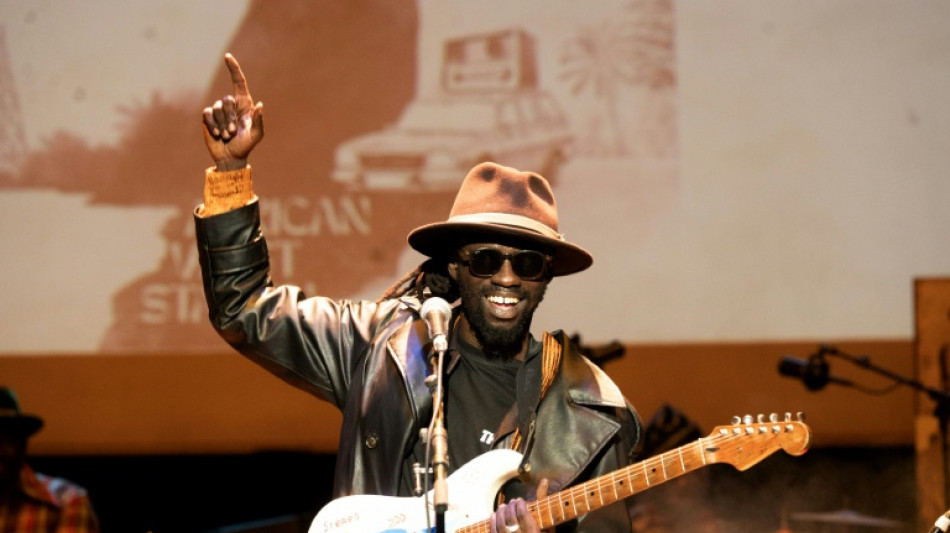
Senegal's Sahad, radiant champion of 'musical pan-Africanism' / Photo: SEYLLOU - AFP



With exhilarating charisma, stage energy and impassioned lyrics, Senegalese musician Sahad has created a unique body of work from a kaleidoscope of influences, culminating in his new pan-African album.
At the heart of Sahad Sarr's ingenuity lies a quest for independence, his pride in being African and a deep connection to Senegal, where he leads a number of projects meant to show young people that it is possible to dream big in the country.
A songwriter, guitarist, singer and founder of his eponymous band SAHAD, the musician has been called the "Senegalese James Brown".
Even if some say there is a touch of Nigerian Afrobeat pioneer Fela Kuti in his trance-like rhythms or a hint of Mali music legend Ali Farka Toure, Sahad's sound is unique.
In his ten years of work, he has become a leading figure in Senegal's alternative music scene, demonstrating that not all of the country's hits have to be in its homegrown Mbalax style.
"The major record labels in Africa, Europe and the United States always have trouble defining my music", Sahad, 37, told AFP.
"I make jazz fusion mixed with Afrobeat, funk, and traditional rhythms from Senegal, Mali and the Serer people", he said, referring to the ethnic community from which he hails.
He says his music is influenced by Miles Davis, John Coltrane and James Brown, explaining that he considers his style "kaleidoscopic".
In recent years he has performed with his band around the world and will represent Senegal at the international jazz music event "jazzahead!" in Bremen, Germany in April.
His latest album "African West Station" is a remarkable work of "musical pan-Africanism", the culmination of four years of research into the archives of post-independence west African music from the 1960s to '80s.
- West African imagination -
"It was important to make an album that recounts the history of all these socio-cultural and political movements, these struggles that have brought us to where we are today", Sahad told AFP.
He emphasised that he wanted "to create a fusion to showcase west African collective imagination" with sounds from Guinea, Mali, Nigeria and Ghana.
The album is meant as a "decolonial plea and a project for unity, where music plays an essential role because it transcends borders."
At the end of January Sahad and his band, who are from Congo, Ivory Coast, Benin and Senegal, delivered a high-energy show at the Institut Francais in Dakar.
As a passionate bandleader, Sahad was not just on vocals but also guitar and percussion.
In "Ya Bon" he criticised current and past African heads of state who he says have maintained a "servile relationship with the coloniser".
In "We Can Do" he aims to inspire youth to build connections, and in his galvanising "Ndakaaru" he celebrates the city of Dakar.
- 'New generation' -
A few days after the concert AFP met with Sahad at his home studio in Dakar.
"There's a new generation in Africa, of which I'm a part, that's demanding a certain freedom, identity, and authenticity, and that also wants to rethink the image portrayed of Africa and Africans," he said.
In the album "we advocate for a youth free from hang-ups, a cultural reappropriation, a new relationship with the world" he said.
He added that he has often been offended by "people who have cliches about African music, who expect Africa to produce a certain type of sound" via instruments such as the kora or percussion.
Thus in 2021 he created his independent label "Stereo Africa 432", which produces music for his own band as well as other emerging Senegalese artists.
He is additionally the founder of the major "Stereo Africa" festival in Dakar, dedicated to contemporary music from the continent and its diaspora, which also provides training to youth in the music industry.
Moka Kamara, cultural journalist at Senegalese newspaper Le Soleil told AFP that there was a palpable revival in the country "with the introduction of a reinvented reggae, a reinvented folk, all of which is thanks to Sahad".
Sahad also founded an eco-village meant to fight climate change, poverty and a rural exodus, in Kamyaak, in western Senegal, where he spends half of his time.
It's a place "for meditation, for reclaiming our culture and our multiple identities" said Sahad, who has been following a Sufi spiritual path for 20 years.
"We sense a wave of revolutions taking place in Africa and a break with this post-colonial trauma, but it cannot happen if we don't arm ourselves with knowledge, understanding and the responsibility of offering something", he said.
A.Aloha--HStB