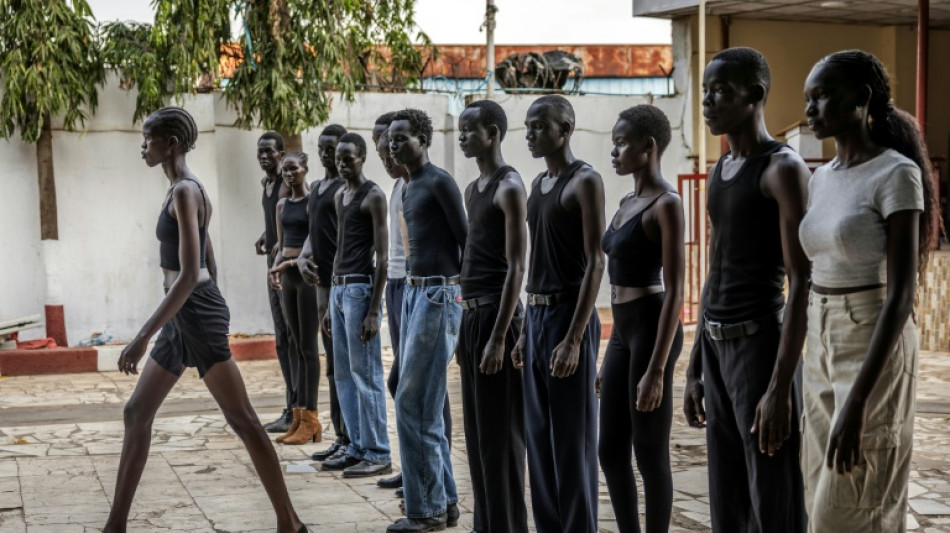
South Sudan models dominate global catwalks but visas a problem / Photo: Luis TATO - AFP

Heels click on cracked paving stones as fantastically long-limbed men and women practice moves they hope will whisk them away from South Sudan, one of the fashion world's favourite scouting locations.
Many hope to follow in the footsteps of their compatriot Awar Odhiang, who went from a refugee camp in Ethiopia to closing Chanel's Paris Fashion Week show last year.
South Sudan has been mired in conflict, poverty and corruption since its independence in 2011, but the success of its models has been a ray of positivity.
No less than nine of the top 50 models currently listed on Models.com are originally from the east African country.
"Paris, Milan, London -- the fashion industry is dominated by South Sudanese boys and girls at the moment," said Doris Sukeji, founder of the Jubalicious modelling agency in the capital Juba.
"Mostly it's the skin colour. That is how most of the South Sudanese get signed. They are looking for very dark models," she said.
One of the first to blaze a trail was Alek Wek, scouted in London in the 1990s after her family fled an earlier war.
It was an image of Wek on her mother's Facebook feed that inspired Yar Agou, 19, now signed with Jubalicious.
"Damn! I saw her and I thought that is me one day if God is there. I want to make it like her," she told AFP in Juba.
All skinny-long limbs and charming attitude, Agou has what it takes for the runway, but politics is standing in the way of her dream.
She was supposed to be working at the recent Milan Fashion Week, but her visa was rejected at the last minute. For now, she is working as a cleaner, hoping there will be more opportunities.
- 'Heartbroken' -
Successful models can earn tens of thousands of dollars in a season, a life-changing amount in South Sudan where 92 percent live under the poverty line.
But Sukeji said seven men and women had been rejected for visas in recent months despite having work sponsors, as the climate against immigrants hardens in the West.
"You get heartbroken," she said.
Bichar Hoah, 24, raised by a single mother in Kakuma refugee camp in neighbouring Kenya, was recently rejected for a European visa.
"There are some people who discourage us by saying that we tried and failed... (but) I want to represent South Sudan as a model," he said, hoping to change the narrative around his country.
- 'A chance' -
But even those who make it abroad face immense challenges in an industry known for relentless turnover.
Clients constantly want "new faces," Sukeji said.
There are added challenges in a conservative country like South Sudan.
As well as physical requirements -- tall but not above 5 foot 11 (1 metre 80) for women -- Sukeji must also contend with families who view modelling as a cover for prostitution.
"I always ask them to give the boy or the girl a chance," she said.
She brings them in for free training, which can take up to three months, taking a 10-percent cut if they get work.
Her trainer, drilling the models with the precision of a military sergeant when AFP visited, said many were like "newborn babies" when they started.
But as the young models gathered on a Juba rooftop to practice their struts, there was hope for a future beyond South Sudan's poverty and ever-present threat of war.
"One day, really, South Sudan will change," said Agou.
All hope they can emulate the likes of Anyier Anei, who landed international modelling gigs and recently starred in French film "Coutures".
"Failure is less frightening than having dreams you never try to achieve," Anei told Harper's Bazaar recently. "Even with fear, you have to take that risk."
X.Mahi--HStB