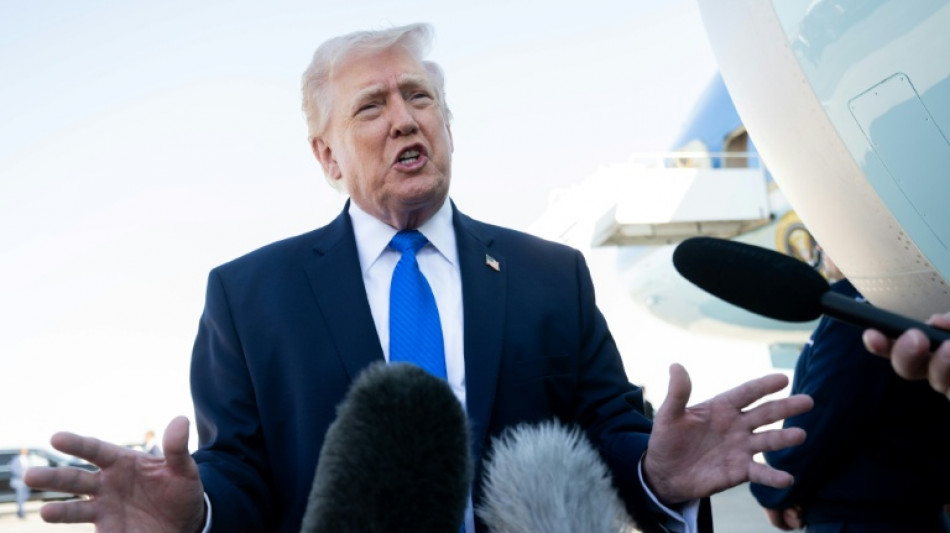
Trump calls off Iran strikes and announces 'very good' talks / Photo: SAUL LOEB - AFP
President Donald Trump shelved plans on Monday to attack Iran's power plants in a stunning about-turn sparked by what he said were "very good" talks with unidentified Iranian officials to bring an end to the war.
The reversal came ahead of a Monday night ultimatum for the Islamic republic to reopen the Strait of Hormuz shipping lane -- or see Trump "obliterate" its power plants.
With observers scrambling to interpret the latest statements from the US leader, oil prices fell and stocks markets jumped, even though Iran denied that any talks were underway.
Trump said his administration was discussing with an unidentified "top person", but not the country's supreme leader Mojtaba Khamenei, who is believed to be injured.
"We've wiped out the leadership phase one, phase two, and largely phase three. But we're dealing with the man who I believe is the most respected and the leader," Trump told reporters in Florida.
He described the individual as "very reasonable," while warning that if the talks failed, "we'll just keep bombing our little hearts out."
In Iran, media outlets quoted the foreign ministry denying any talks and suggesting Trump was angling to bring down energy prices sent soaring by the war -- with no mention of his claim on state television's latest news bulletin.
In a post on his Truth Social site, Trump said he had told the Pentagon to "postpone any and all military strikes against Iranian power plants and energy infrastructure for a five day period, subject to the success of the ongoing meetings."
Trump's threat to bomb Iran's power infrastructure had raised fears of a major escalation that could have seen the conflict expand again, with huge consequences for Gulf countries that host US forces.
In response, Iran had threatened to deploy naval mines in the Gulf and target power plants across the region -- ramping up its rhetoric after warnings the world faced an energy crisis of historic proportions if the US-Israeli war with Iran drags on.
- Strikes -
Tehran has retaliated against US-Israeli attacks by throttling traffic through the Strait of Hormuz, conduit for a fifth of global crude, hitting energy sites and US embassies across the Gulf as well as targets in Israel.
The head of the International Energy Agency Fatih Birol warned overnight that, in the event of a protracted war, daily oil losses put the world on track for a crisis worse than the combined impact of both 1970s oil shocks and Russia's invasion of Ukraine.
Oil prices have been driven above $100 a barrel by the conflict -- and they tumbled sharply after Trump's announcements, while European stocks rebounded.
International benchmark Brent North Sea crude plunged around 10 percent to $101.00 per barrel, while the main US oil contract West Texas Intermediate shed around nine percent to $89.35 per barrel.
"I welcome the talks reported between the US and Iran," British Prime Minister Keir Starmer told a parliamentary committee, adding the UK was "aware" discussions were happening.
Since the start of the war on February 28, Trump has repeatedly stated his desire for regime change and openly raised the idea of installing a pro-Western figure from inside Iran's government.
Tulsi Gabbard, director of US national intelligence, told Congress last week that she assessed "the regime in Iran to be intact but largely degraded due to attacks on its leadership and military capabilities".
- Lebanon ground campaign -
The US president has offered varying timelines and objectives for the war, saying Friday he was considering "winding down" the operation -- only to later threaten Iran's power plants, of which it has more than 90.
Israeli Prime Minister Benjamin Netanyahu, who has yet to comment on Trump's announcement, has spoken of a long-term campaign against Iran's government, a state sponsor of Hamas, which launched the October 7, 2023 attack triggering the Gaza war.
In Lebanon, Israel has also expanded its ground campaign against Iran-backed Hezbollah, warning of "weeks of fighting" there.
The Lebanon violence has killed more than 1,000 people and displaced more than a million, according to the health ministry.
On Monday Israel's military said it was working to intercept a new salvo of missiles from Iran -- while confirming its own artillery fire had killed an Israeli civilian a day earlier near the Lebanese border.
In a sign of the conflict's tentacular impact, the world's second economy China had said earlier Monday it was capping domestic fuel cost increases to mitigate the effect of surging oil prices.
burs-ec-adp/ser
Z.Hanohano--HStB