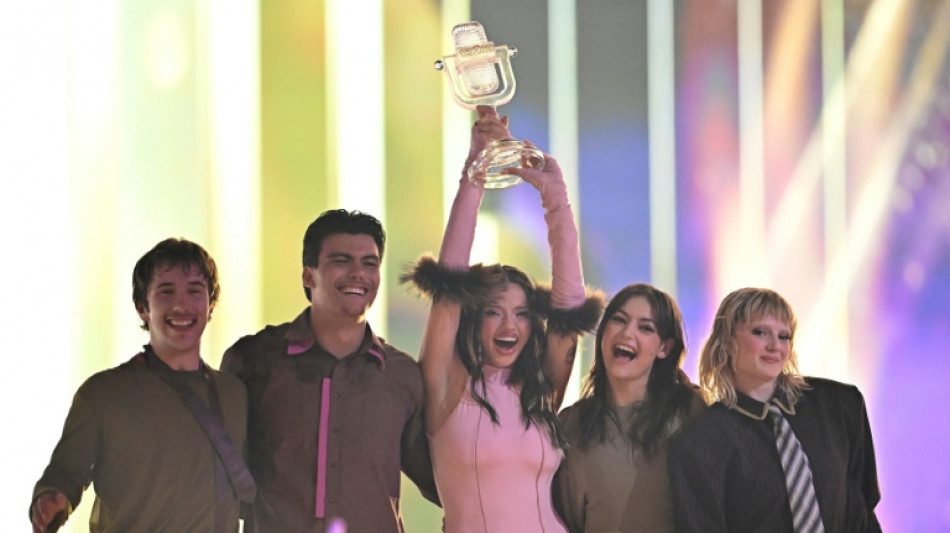
Dara: dancing to victory at Eurovision / Photo: Tobias SCHWARZ - AFP

Already a household name in her native Bulgaria, pop singer Dara secured her place on the international stage by winning Eurovision with her infectious song "Bangaranga", which aims to show "everything is possible".
The 27-year-old upset the odds to secure her country's first-ever victory at the Eurovision Song Contest, proving herself a winner once the votes came in from around the continent.
She gained traction during Eurovision week with her intense and ultra-choreographed dancing on the catchy "Bangaranga".
Ahead of the final, Dara herself said she did not expect a win.
"I don't expect anything. And when presents come for me, I just hug them. And yeah, I'm really grateful," she told Bulgarian national TV after Thursday's semi-final.
"I love being on stage and I love what I felt during the performance... I'm so grateful for that, for the support that I get," she said.
- 'Everything is possible'
Singing in English, her song's title is a Jamaican Patois slang term that means "riot".
"Bangaranga, it's a feeling that everybody got in themselves. It's the moment that you choose to lead through love and not fear and this is a special energy," she said.
"Once you feel at one with the nature and the universe you will feel the harmony that you can be whatever you want to be and everything is possible."
Darina Yotova was born in the Black Sea port city of Varna, where she graduated from the National School of Arts.
She began singing traditional Bulgarian folklore music at the age of seven before later shifting her focus toward contemporary pop.
She became known to the general public thanks to her participation in X Factor Bulgaria in 2015.
Her debut single, "K'vo ne chu" ("What Didn't You Hear") released in 2016 catapulted her to the top of the music charts.
Her career has since been marked by numerous awards, sold-out concerts and a massive fan base, with her songs and videos amassing millions of views.
In 2018, Dara was named "Best Woman Artist" at the BG Radio Music Awards.
Three years later, she became the youngest-ever coach on "The Voice of Bulgaria", and in 2024, she took part in "Dancing Stars".
Last year, Dara was selected to open for Robbie Williams at his concert in Sofia.
Asked ahead of the final what it meant to represent Bulgaria, Dara said "it means a lot because we as Bulgarians should have a bigger platform for all of our artists, songwriters, everybody in the creative community. And Eurovision is just a platform for this".
Bulgaria returned to Eurovision this year after missing the contest since 2022 due to financial reasons. It first joined in 2005.
- 'Hyperactivity' -
Her latest album, "ADHDara," is inspired by her "hyperactivity".
"This syndrome and all these things I'm trying to fight against are part of me," Dara told Bulgarian television station bTV in September.
Videos on social media "rarely hold people's attention for more than six seconds," said the singer, adding that she has to keep up with this fast pace to stay in touch with her fans.
Dara's success has given Bulgarian society a rare moment of unity in a fragmented country, stirring memories of 1994, when the national football team finished fourth in the World Cup.
"You already hold first place in the heart of all of Bulgaria! You’re going to conquer Europe as well," Bulgarian President Iliana Iotova wrote on Facebook before the final.
The singer was certainly able to count on the support of the large Bulgarian diaspora.
Since the borders opened in 1989, many Bulgarians have settled abroad.
Nearly three million Bulgarian nationals live outside the country, according to the foreign ministry.
The Balkan EU member has a population of 6.5 million.
O.Kawai--HStB