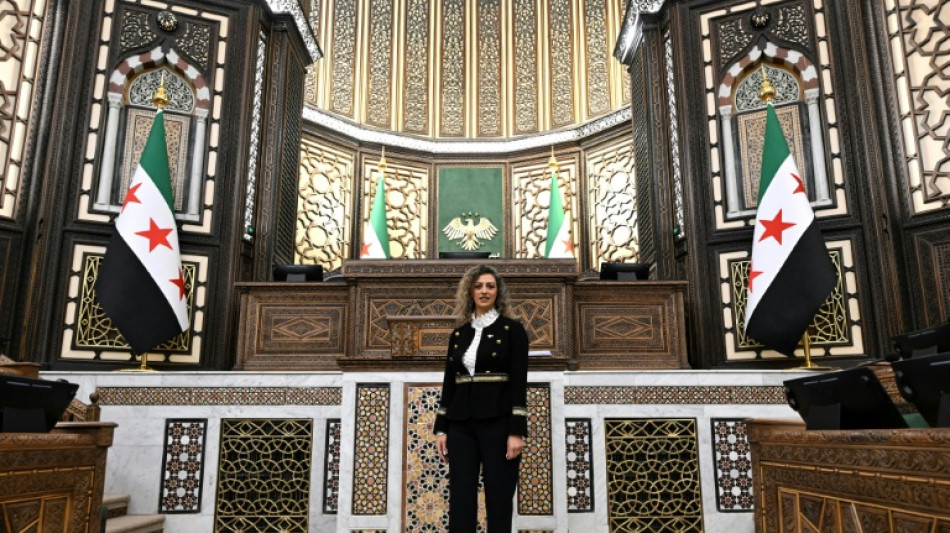
Actress, engineer, jihadist's widow among Syria's new women MPs / Photo: LOUAI BESHARA - AFP
In Syria's first post-Assad parliament, women lawmakers stand out more for their diversity than their numbers: a famous actress, a Christian engineer, a Kurdish leader and the widow of a hardline Islamist commander.
Women hold 22 of the 207 current seats in Syria's parliament, or just over 10 percent, similar to the previous assembly under longtime ruler Bashar al-Assad, who was toppled by an Islamist alliance in 2024 after more than a decade of civil war.
The parliament held its opening session in July, though some of its seats have yet to be filled.
With 15 of the women appointed by President Ahmed al-Sharaa, the lineup likely reflects the new authorities' keenness to demonstrate inclusivity following criticism that women and minorities have been under-represented in the country's post-war transition.
- TV actress -
Glamorous actress Rouzaina Lazkani, 36, known for television dramas, was catapulted into politics when she was among the 70 lawmakers appointed by Sharaa under the country's transitional constitutional arrangements.
Lazkani, who studied dramatic arts in Damascus and never imagined playing a political role, learned of her appointment two days before it was announced publicly.
"I thought one of my colleagues was playing a trick on me," she said in a television interview.
Her native Hama, in central Syria, is notorious for a 1982 massacre under Assad's father, Hafez, who cracked down on a revolt there by Islamist group the Muslim Brotherhood.
Her appointment caught many by surprise due to her artistic, apolitical background.
Confessing she was "certainly not well-versed in politics", Lazkani said that "at this stage, I feel I deserve prayers more than blessings".
- Christian academic -
Madonna Beshara, 38, one of parliament's deputy speakers, was a civil engineering professor before being appointed by Sharaa.
She told AFP from her parliamentary office that she felt a "mixture of joy and responsibility".
"The number of women may not fully represent the importance of the presence of women in Syrian society, but it is a good start," she said.
Their "presence under this dome is the beginning of a path that must go beyond symbolism to legislation and influence".
A devout Christian, Beshara expressed hope that she and her colleagues would lead "a legislative revolution befitting Syria" that would bring all citizens safety after more than 13 years of war.
- Kurdish leader -
Kurdish lawmaker Fasla Yousef, 56, was selected by an electoral body in the northeast province of Hasakeh.
She is also part of the Kurdish National Council, a coalition of parties that opposed Assad's rule but had no role in the Kurdish administration that for years controlled swathes of the country's north and northeast.
"We represent all Syrians, while I am also a representative of the Kurdish community and people, so I have double the responsibility," said Yousef, who attended her first parliamentary session dressed in traditional attire.
A January integration deal between Damascus and the Kurdish administration crushed Kurdish aspirations for self-rule and still raises concerns for many from the minority group.
Yousef, whose community strongly promotes gender equality, said she also wants to work on "defending women's rights and enshrining them in the country's constitution".
- Novelist -
Novelist Nour Jandali was chosen by Sharaa as a representative for Homs, a bastion of anti-Assad protests.
She told AFP she hoped parliament would be a space "to open dialogue for all Syrians from all backgrounds".
A veteran anti-Assad activist, Jandali, 48, lived through siege and exile and has written more than 20 books.
"We are eager to talk and understand each other in a different way," said Jandali.
Under Assad, lawmakers were "tools in the hands of the authorities", she said, vowing instead that she "entered the assembly to bring about change."
- First niqab-wearing MP -
Mirvat Toutou, also appointed by Sharaa, has a degree in commerce and economics and was a teacher for 13 years in Idlib, in the country's northwest.
She is Syria's first-ever lawmaker to wear the full-face Islamic niqab veil.
Her husband was Abu Omar Saraqeb, who commanded a coalition of Islamist and jihadist factions that took control of Idlib in 2015 and was killed in an airstrike the following year.
Sharaa, himself a former jihadist, headed one of the factions at the time.
In one of his first television interviews after taking power, Sharaa said he remembered Abu Omar when he entered Damascus victorious after toppling Assad in December 2024.
Last year, he welcomed Toutou to the presidential palace as part of a ceremony honouring families of the "martyrs".
Another lawmaker was Aisha al-Dibs, the first woman the new authorities appointed to a governmental position, one she no longer holds.
She headed the country's women's affairs office for a few months, but is best-known for having sparked uproar after urging women "not to go beyond the priorities of their God-given nature", and to know "their educational role in the family".
Z.Hanohano--HStB