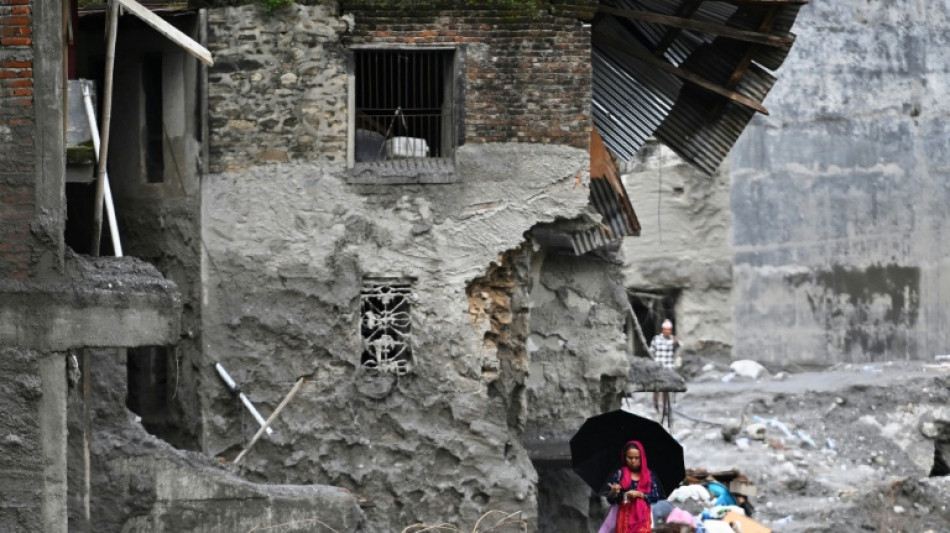
China-Nepal flood toll tops 1,000 as tunnel rescue offers last hope / Photo: Arun SANKAR - AFP



The death toll from devastating Himalayan glacial floods crossed the grim 1,000 mark on Tuesday, as Chinese and Nepali teams searched for survivors including dozens feared trapped in hydropower tunnels.
Nearly 4,500 people are missing after the gigantic wave of freezing water, rocks and debris from a high-altitude glacial collapse roared downstream on Wednesday, wiping out entire settlements and gouging a path of destruction through Nepal.
Nepali rescue teams are digging, drilling and blasting through debris in a race against time in treacherous conditions to free around 100 hydropower workers believed trapped in multiple tunnels.
So far, only corpses have been pulled out of tunnels blocked with sludge.
"We are focused on search and rescue efforts at the tunnels, our work is continuing," Raja Ram Basnet, Nepal Army spokesman, told AFP on Tuesday.
"Our soldiers are also deployed to collect bodies and prevent the spread of disease."
With mortuaries overflowing in Nepal, the authorities have begun burying hundreds of unidentified bodies after DNA sampling. At least 17 bodies have also been pulled from rivers far downstream in India.
Nepal's Prime Minister Balendra Shah has called the catastrophe "unimaginable and heartbreaking".
- 'Find their bodies' -
In the capital Kathmandu, crowds lined up to search for their missing relatives, posting photographs on a long wall outside a hospital, in the fading hope of finding them alive.
Debu Sapkota, a 58-year-old driver, came to post photos of his 83-year-old mother-in-law and granddaughter who went missing in the town of Trishuli Bazaar, after being swept away by last week's surge.
A warning alert sounded, but the elderly woman was "too old to run", he recounts.
"Her granddaughter was helping her escape but both were swept away."
Sapkota says he no longer has "any hope that they survived", after witnesses saw them being carried away by the torrent.
"I am here hoping to find their bodies," he said, holding up photos of the two missing women dressed in traditional clothes.
In Chitwan district, mourning relatives cremated some of the dead.
Soldiers were seen unloading bodies of victims from helicopters in Nepal's Nuwakot and Rasuwa districts.
Aid needs are enormous. Entire communities have been swept away, leaving families homeless and using makeshift shelters as heavy rain lashes down.
Roads and dozens of bridges have been smashed, and power plants destroyed.
"There are too many challenges," said police officer E. Hawadi in badly affected Nuwakot district.
- 'Climate change' -
In Nuwakot, AFP photographers on Tuesday saw people scouring through mud into the rubble of their homes for usable items, some clearing away dirt and stringing up plastic sheeting for shelter in the ruins.
Foreigners missing among the list include 583 in Nepal and 261 in China, coming more than 30 nations.
They include tourists who had come for trekking in the apparently serene Himalayas, as well as Hindu pilgrims seeking spiritual peace at Tibet's sacred Mount Kailash.
There is growing anger at the scale of destruction to hit Nepal, a largely rural nation of 30 million people -- that has contributed little to the emissions driving global warming churned out by wealthy and industrialised nations, but is suffering its consequences.
"It is now time for us to strongly raise with the international community the issue of the disasters we are experiencing as a result of climate change," Shah, Nepal's prime minister, said in a statement late Monday.
Scientists say the Himalayas, the world's highest mountain range, are melting faster as global temperatures rise.
Nepal's economy is already under pressure, with limited resources to respond to a disaster of this scale, with Kathmandu warning reconstruction costs could run into the "billions of dollars".
- 'Mourn the victims' -
Nepal said 987 bodies had been recovered, and listed 3,916 as missing.
China's state media reports 16 dead, and 546 people missing.
That takes the overall number of dead to 1,003, and missing to 4,462.
In China, Tibet is largely inaccessible to foreign journalists, and Chinese authorities are the only source of official information.
Emergency workers, officials and residents in Tibet held memorial services on Tuesday.
"Rescuers, local officials and residents stood in silence to mourn the victims," China's official news agency Xinhua said.
More than 2,000 people are aiding rescue operations, including soldiers, Xinhua added.
It said on Tuesday that teams were "working around the clock to search for survivors, repair roads, set up communication base stations and restore power lines."
But Tibetan advocacy groups in exile have questioned China's account of the disaster.
Tencho Gyatso, president of the International Campaign for Tibet, called for China to disclose "complete and verifiable information about the damage and casualties".
Beijing's foreign ministry said Monday that the "release of information has been open, transparent and timely", and rejected international reports that it was underreporting deaths.
burs-pjm/hmn
F.Kawika--HStB