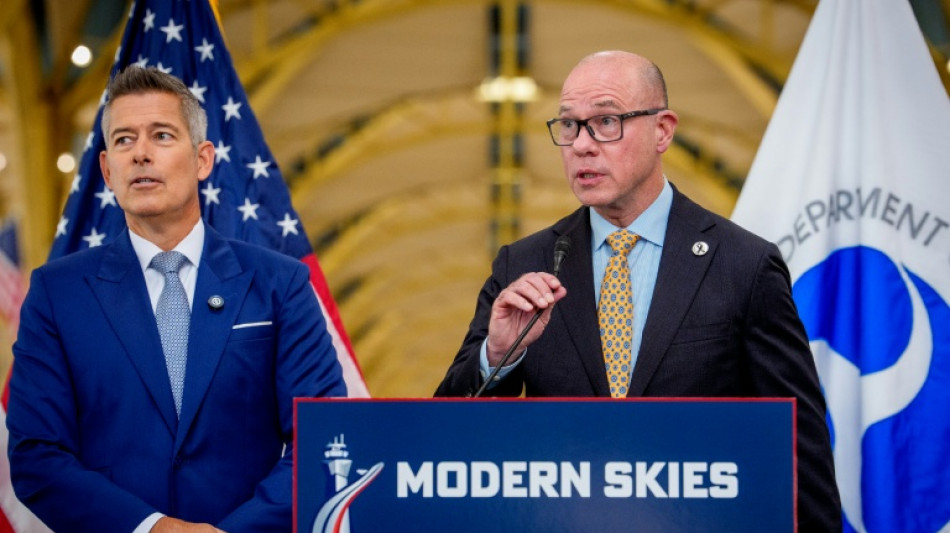
Certification of Boeing 737 MAX delayed by software bug / Photo: Andrew Harnik - GETTY IMAGES NORTH AMERICA/AFP
US air safety regulators are delaying certification of the 737 MAX 10 until determining a fresh software glitch poses no safety risk, a top official said Monday.
The problem stems from a cockpit software update to the 737 MAX that can cause an automated navigation feature to fail when planes shift their approach to landing.
Shares of Boeing, which has staked its turnaround in part of MAX production growth, fell sharply Monday after a weekend Wall Street Journal article outlined the problem.
While pilots are trained to safely land planes without the automated navigation system, regulators must evaluate whether the "workload" is excessive for pilots under such a scenario, said FAA Administrator Bryan Bedford.
Bedford said Monday at a press conference that the MAX planes certified by FAA thus far are safe but that "we will be delaying the 10 until ... we're satisfied we don't have an issue here."
Earlier, an FAA spokesperson said the regulator "is working closely with Boeing and the airlines," adding that the FAA will convene an advisory board and "will take immediate action if it identifies a safety concern."
The statements come after Boeing Chief Executive Officer Kelly Ortberg told a Wall Street conference on September 16 that he expected Federal Aviation Administration certification of the 737 MAX 10 "very soon."
A Boeing spokesperson said Monday that, "we continue to follow the lead of the FAA as we work through the certification process."
The problem surfaces when pilots alter their preprogrammed flight plan following a missed approach, according to Boeing.
"Last month, we informed all 737 operators about a software issue where pilots may not have access to automated flight guidance during a specific landing scenario," a Boeing spokesperson said Monday in an emailed statement.
"We shared information with operators that reinforced existing pilot procedures for safely handling such cases."
Boeing engineers "are working on a software update to permanently address the issue," the spokesperson said.
- Boeing's woes -
Boeing has staked its corporate turnaround in part on growth of 737 MAX production. The aircraft was grounded for 20 months through November 2020 following fatal MAX crashes in 2018 and 2019.
Airlines have been eager to receive the 737 MAX 10, which, like other Boeing jets, has been heavily delayed by the company's safety problems.
The FAA certified the smaller, long-delayed 737 MAX 7 on August 3.
Bedford said the 737 MAX 7 is "safe" to fly, describing the software issue as akin to an update for iPhone or a Microsoft product. In this instance, Boeing "fixed a known bug" but introduced "a new bug, smaller."
Bedford described the issue as very different from the flaw that led to the two deadly MAX crashes.
In those cases, a poorly conceived flight navigation system known as the Maneuvering Characteristics Augmentation System (MCAS) took control of the aircraft.
"The pilots remain in control of the airplane," Bedford said of the new software defect. "They train for these scenarios."
Three major MAX buyers told AFP they don't fly planes with the problematic new version of the flight management computer software.
"United does not currently have any 737s operating with this new FMC software, and we are not taking deliveries of new aircraft with the new FMC software," United said.
Southwest Airlines "is aware of the issue and is engaged with Boeing and the FAA," said a spokesperson for the carrier who added that all newly delivered planes have older software versions installed.
"We have been engaged with Boeing and the FAA and will continue to work closely with both as they evaluate this matter and determine next steps," said a spokesperson for Alaska Airlines, which also does not fly aircraft with the new software.
Shares of Boeing finished at $184.39, down 6.9 percent
F.Lono--HStB