India student protests keep up pressure on Modi government / Photo: Sajjad HUSSAIN - AFP



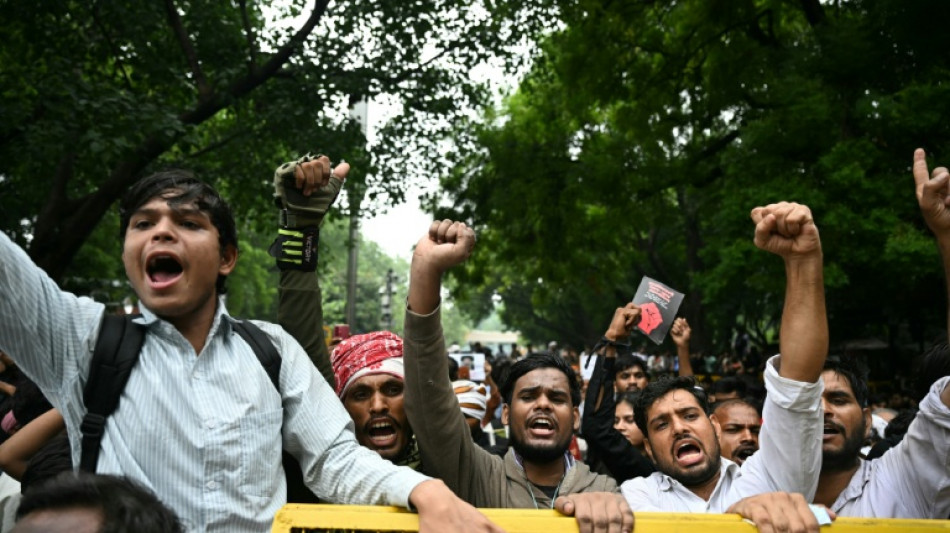
Crowds of supporters of India's online "cockroach" movement grew on Wednesday at a New Delhi protest site, with their campaign for accountability and reform following examination scandals getting a boost inside parliament from opposition lawmakers.
The protests, led by the social media-driven Cockroach Janta Party (CJP) movement, have emerged as one of the biggest challenges to Prime Minister Narendra Modi's government since his re-election in 2024.
The protesters, demanding the resignation of Education Minister Dharmendra Pradhan, have refused to leave the Jantar Mantar site in the heart of the Indian capital, with crowds swelling to several thousand people on Wednesday, according to AFP correspondents.
"We will not leave Jantar Mantar until Dharmendra Pradhan resigns," CJP spokesman Ashutosh Ranka told cheering supporters.
"In the country where people had forgotten how to ask questions, in the country where criticising the government was considered treason -- we have now awakened that country."
The protesters, most of them young students, got a major boost on Tuesday after opposition parties threw their weight behind their movement, staging a sit-in outside the prime minister's residence.
Rahul Gandhi, a senior leader of the Congress party, is asking the government to apologise for the police crackdown on tens of thousands of protesters on Monday.
Gandhi, 56, who was briefly detained on Tuesday, appeared in parliament on Wednesday dressed in black, demanding accountability from the government.
The opposition Samajwadi Party staged a protest in the parliament premises, with leader Akhilesh Yadav saying Modi has remained silent on an issue which affects every young Indian.
- 'Keep going' -
The CJP movement, which has millions of followers on social media, emerged in May initially as a satirical response to Chief Justice Surya Kant reportedly likening young people to "cockroaches" and "parasites" during a court hearing, sparking outrage.
The movement has broadened its agenda to include concerns over unemployment, opportunities for young people and what it describes as Modi's increasingly authoritarian style of governance.
On Monday, police fired tear gas and baton-charged demonstrators as they tried to march to parliament on the opening day of the monsoon session.
As tensions escalated, protesters responded by hurling stones, marking the capital's largest street rally in five years.
Rights groups have accused police of using excessive force.
"The Delhi Police's actions raise serious questions about whether their response met the requirements of legality, necessity, and proportionality under international human rights standards," Amnesty International said in a statement.
India's Supreme Court on Wednesday refused to hear a petition alleging police brutality against the protesters.
At the Jantar Mantar site, where a group of activists has been camping for nearly a month, one protester on Wednesday said it was the first time the country's youth had an opportunity to raise their voice.
"I am scared because on Monday I saw the police beating people and using force, but we have no choice but to keep our movement going," Kavya, a 20-year-old student who gave only her first name, told AFP.
- Minister promises 'solutions' -
The protests follow several exam irregularities, including the leak of India's medical entrance examination paper that forced more than two million candidates to retake the test.
Another dispute involving the online marking of examinations taken by nearly two million high school students has also fuelled public anger.
Pradhan, the education minister facing growing pressure particularly over the medical school examination, said the government remained committed to reform and discussing the issue in parliament.
"We owe them (students) answers, reforms and accountability," he said in a social media post late Tuesday, in his first public comments since Monday's protests.
"They deserve certainty over chaos, solutions over slogans and responsibility over disruption."
Support for the CJP has grown beyond Delhi, with smaller protests also being held in Mumbai, Bengaluru and Goa.
L.Kekai--HStB