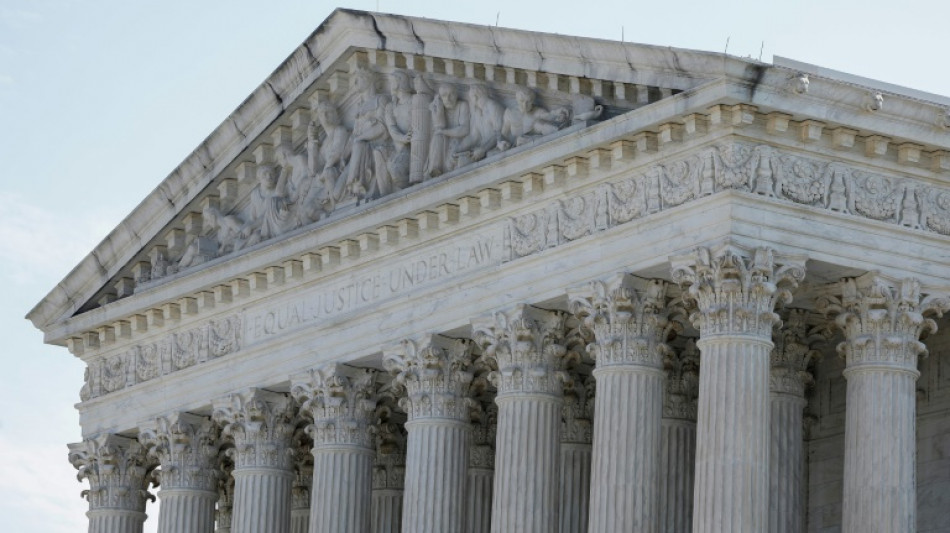
US Supreme Court hears Bayer bid to end Roundup weedkiller suits / Photo: Anna Moneymaker - GETTY IMAGES/AFP


The US Supreme Court heard a bid on Monday by German agrichemical giant Bayer to put an end to a wave of lawsuits over the weedkiller Roundup.
Bayer has spent more than $10 billion settling litigation linked to Roundup since it acquired its producer, the US agrochemical group Monsanto, in 2018.
The World Health Organization's International Agency for Research on Cancer (IARC) considers glyphosate, one of Roundup's ingredients, a probable human carcinogen, but Bayer says scientific studies and regulatory approvals show the widely used weedkiller is safe.
The top US court agreed to hear Bayer's appeal of a $1.25 million Missouri jury award to a man, John Durnell, who claimed Roundup was responsible for his cancer -- one of thousands of similar "failure-to-warn" lawsuits facing the company.
Bayer is arguing that it should be shielded from state lawsuits since the federal Environmental Protection Agency (EPA) approved the sale of Roundup to consumers and farmers without any warnings.
"Every agency around the globe -- New Zealand, Japan, Australia, the European Union, Canada -- they've looked at glyphosate," Paul Clement, an attorney for Bayer, told the justices.
"It's probably the most like studied herbicide in the history of man and they've all reached the conclusion based on more data and the kind of expert analysis they can do that there isn't a risk here," Clement said. "You shouldn't let a single Missouri jury second-guess that judgment."
The Trump administration has backed Bayer's stance that a federal statute on pesticide labels preempts state laws requiring warnings on products that may be carcinogenic.
It's not feasible to have 50 different states coming out with their own determinations, Deputy Solicitor General Sarah Harris said.
"Iowa says maybe this causes cancer. California says absolutely causes cancer. Some other state says this doesn't cause cancer at all, so put that on your label too," Harris said. "It completely undermines the uniformity of the labeling."
Clement, the Bayer lawyer, also stressed a need for maintaining uniformity.
Failure to do so would "open the door for crippling liability and undermine the interest of farmers who depend on federally registered pesticides for their livelihood," he said.
Ashley Keller, a lawyer representing Durnell, who blames his non-Hodgkin lymphoma on exposure to Roundup, said the EPA's analysis of the weedkiller should not be the final word.
"I think there are a lot of conscientious people working at that agency," Keller told the court. "I think we should also all agree that things slip through the cracks with that agency."
The Supreme Court is expected to issue a ruling in the case by June or early July.
B.Kekoa--HStB