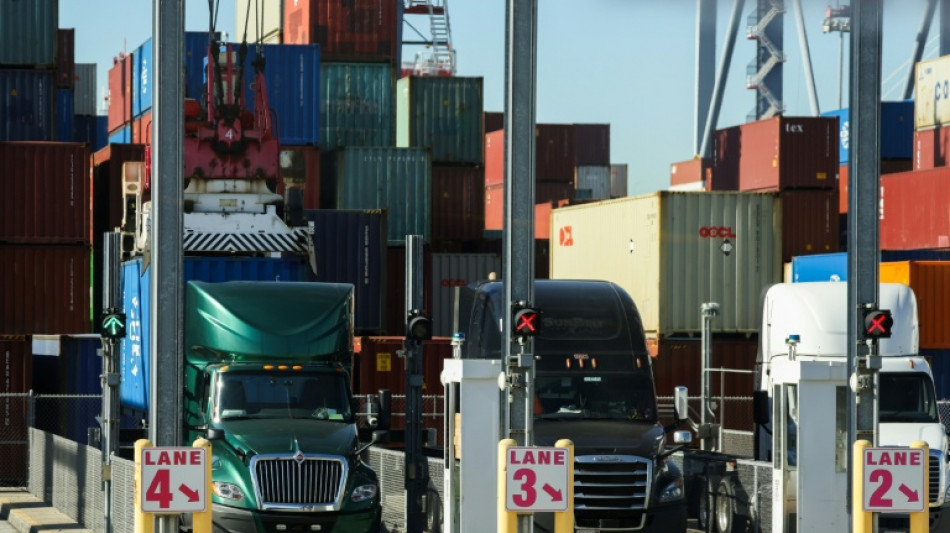
US trade deficit in goods widens to new record in 2025 / Photo: Patrick T. Fallon - AFP/File

The US trade deficit in goods expanded to a new record in 2025, government data showed Thursday, despite sweeping tariffs that President Donald Trump imposed during his first year back in the White House.
The US goods deficit stood at $1.24 trillion for all of last year, widening slightly from 2024's level to its biggest in Commerce Department figures dating back to 1960.
But the trade gap in goods with China narrowed for the full year, as US imports from the world's second-biggest economy dropped by 30 percent.
When both goods and services were considered, the overall US trade deficit for 2025 narrowed to $901.5 billion, from $903.5 billion in 2024.
In the month of December, the overall deficit grew more than expected by 32.6 percent to $70.3 billion, as exports fell and imports climbed.
Trade flows involving the world's biggest economy were heavily swayed in 2025 as Trump slapped fresh tariffs on goods from virtually all trading partners after returning to the presidency, as part of a push to reduce the US trade gap.
His moves brought the average effective tariff rate to its highest since the 1930s.
Chad Bown of the Peterson Institute for International Economics told reporters Thursday that the uptick in imports was likely due in part to the United States' artificial intelligence build-out.
This covers high-tech imports like advanced semiconductors, primarily manufactured in Taiwan, that eventually go towards data centers.
Another factor could be that Trump's waves of tariffs last year also contained significant exemptions, such as for electronic products like smartphones.
The shift in trade flows with China came as Trump engaged in tit-for-tat tariff escalations with Beijing in April. Tensions between both countries have since cooled.
But the overall imports figures likely reflect changes in where companies are sourcing their goods from, turning to countries like Vietnam for example, as the US-China relationship remained turbulent.
Trump has been quick to attribute his country's economic growth and other achievements to his sweeping tariffs, saying on social media that they have "rescued our economy and national security."
But a New York Federal Reserve paper noted this month that nearly 90 percent of the tariffs' economic burden fell on American firms and consumers.
In December, exports of industrial supplies including nonmonetary gold dropped, while imports in the same category rose for the month.
US imports of capital goods like computer accessories and telecommunications equipment picked up in the month.
Y.Kapu--HStB