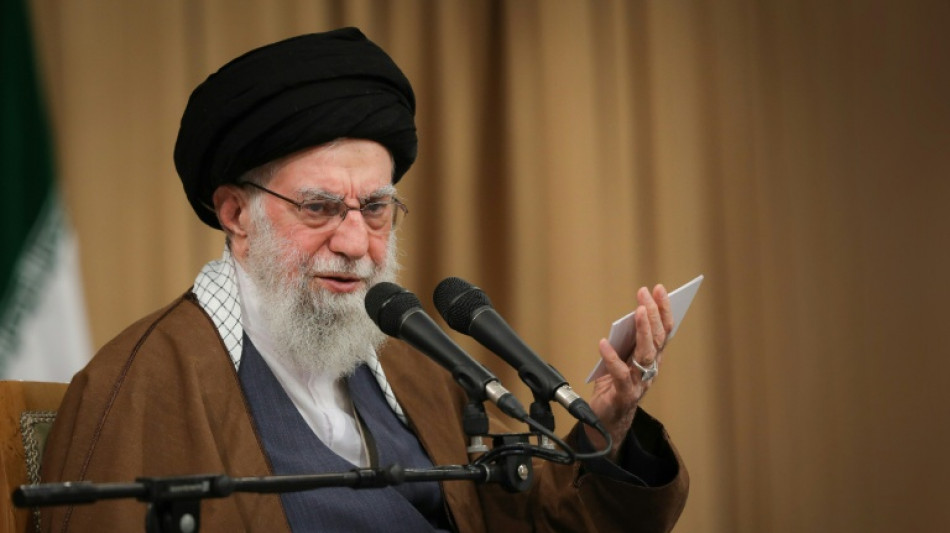
Iran's Khamenei: ruthless revolutionary atop Islamic republic / Photo: - - KHAMENEI.IR/AFP/File

Iran's supreme leader Ali Khamenei, a pillar of its theocratic system since the Islamic revolution whose death was announced by US President Donald Trump on Saturday, saw off multiple crises over the decades, remaining defiant to the very end.
There has been no confirmation from Tehran of his death, but Trump posted on his Truth Social site that "Khamenei, one of the most evil people in history, is dead" after the United States and Israel launched a massive wave of strikes targeting sites across Iran, including the supreme leader's Tehran compound.
Aged 86, Khamenei dominated Iran for the last three-and-a-half decades since taking on the post for life in 1989 as leader of the Islamic republic following the death of revolutionary founder Ayatollah Ruhollah Khomeini.
He remained in power after overcoming 1999 student demonstrations, 2009 mass protests sparked by disputed presidential elections and 2019 demonstrations that were brutally suppressed.
He also survived the 2022-2023 "Woman, Life, Freedom" movement sparked by the death in custody of Iranian Kurdish woman Mahsa Amini, who had been arrested for allegedly violating the strict dress code for women.
Khamenei was forced to go into hiding during the 12-day war against Israel in June, which exposed deep Israeli intelligence penetration of the Islamic republic that led to the killing of key security officials in air strikes.
But he survived that war and, after nationwide protests again shook Iran earlier this year, he emerged defiant as ever.
- Tight security -
Khamenei lived under the tightest security, and his relatively infrequent public appearances were never announced in advance or broadcast live.
As supreme leader he never set foot outside the country, a precedent set by Khomeini following his triumphant return to Tehran from France in 1979.
Khamenei's last known foreign trip was an official visit to North Korea in 1989 as president, where he met Kim Il Sung.
There had long been speculation about his health given his age, but there was nothing in his most recent appearance to fuel any new rumours.
Khamenei's right arm was partially paralysed following an assassination attempt in 1981 that authorities have always blamed on the People's Mujahedin of Iran (MEK) group, one-time allies of the revolution now outlawed in the country.
- 'I am opposed' -
Repeatedly arrested under the shah for his anti-imperial activism, Khamenei shortly after the Islamic revolution became Friday prayer leader of Tehran and also served on the front line during the Iran-Iraq war.
He was elected president in 1981 following the assassination of Mohammad Ali Rajai, another attack blamed on the MEK.
During the 1980s, Khomeini's most likely successor was seen as the senior cleric Ayatollah Hossein Montazeri, but the revolutionary leader changed his mind shortly before his death after Montazeri objected to the mass executions of MEK members and other dissidents.
When Khomeini died and the Islamic republic's top clerical body the Assembly of Experts met, it was Khamenei whom they chose as leader.
Khamenei famously initially rejected the nomination, putting his head in his hands in a show of despair and declaring, "I am opposed". But the clerics stood in unison to seal his nomination and his grip on power never slackened.
Khamenei worked with six elected presidents, a far less powerful position than supreme leader, including more moderate figures such as Mohammad Khatami who were allowed to make stabs at cautious reform and rapprochement with the West.
But in the end, Khamenei always came down on the side of hardliners.
He was believed to have six children although only one, Mojtaba, had public prominence. He was placed under sanctions by the United States in 2019 and is one of the most powerful backstage figures in Iran.
A family dispute also caught attention: his sister Badri fell out with her family in the 1980s and fled to Iraq in the war to join her husband, a dissident cleric.
Some of their children, including a nephew who is now in France, became vehement critics.
H.Lono--HStB