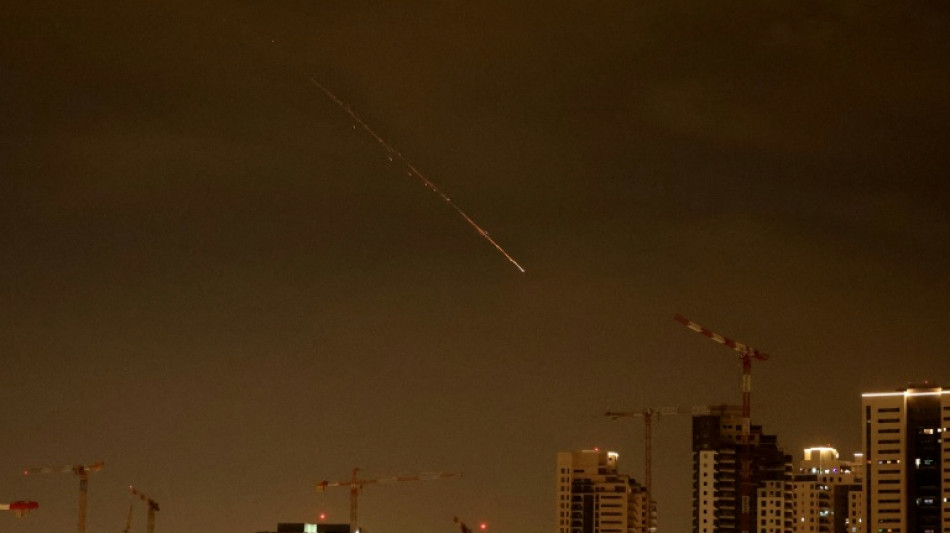
Iran fires missile salvo after Trump signals progress in talks / Photo: JACK GUEZ - AFP
Iran launched a new missile salvo across the Middle East on Wednesday, after US President Donald Trump's signals that he was eager to talk with Tehran steadied global markets.
Oil prices dropped sharply and stocks in Asia rose on broader de-escalation hopes following nearly four weeks of war, as Trump appeared to be ramping up efforts to bring an end to his joint military operation with Israel.
Trump, whose daily statements have swung wildly from threatening to conciliatory, said Washington was "in negotiations right now" with Tehran.
"They did something yesterday that was amazing actually. They gave us a present and the present arrived today. And it was a very big present worth a tremendous amount of money," he told reporters in the Oval Office.
"That meant one thing to me -- we're dealing with the right people."
The US leader did not explain further but said it related to the Strait of Hormuz, which Iran has largely blockaded in retaliation for US and Israeli strikes, spiking global energy prices.
Iranian officials have yet to confirm any formal talks.
However, the New York Times -- quoting several unnamed officials -- reported that Washington has sent a 15-point plan to Iran via Pakistan, which has offered to mediate, in a bid to end the war.
It was not clear if Israel, which has been carrying out strikes on Iran and ally Hezbollah in Lebanon, was aware or on board with the plan.
Trump's cryptic statements on his eagerness to talk with Iran included repeating a claim that Tehran has "agreed they will never have a nuclear weapon".
Iran had agreed in 2015 to broad restraints on its contested nuclear program in a deal that Trump ripped up during his first term as he joined Israel in applying pressure to the cleric-run state.
Despite the US leader's stated hopes for a deal, The Wall Street Journal reported that Washington is planning to send a further 3,000 soldiers to the Middle East.
- Fresh Gulf attacks -
While Trump hinted at backchannel diplomacy, Iran's Revolutionary Guards said they had fired a fresh wave of missiles Wednesday at Israel, as well as bases hosting US forces in Kuwait, Jordan and Bahrain.
The Islamic republic has kept up its retaliatory attacks on Israel and Gulf nations it accuses of serving as launchpads for US strikes.
Drones hit a fuel tank and sparked a fire at Kuwait International Airport, the Gulf state's civil aviation authority said, causing "limited" damage.
In Bahrain, the interior ministry said air raid sirens were activated, while Jordan's public security directorate reported shrapnel fell near the capital Amman, resulting in no casualties or damage.
Saudi Arabia said it had intercepted at least four drones in the kingdom's east.
Israel meanwhile said it was launching new strikes on "infrastructure of the Iranian terror regime" after announcing new Iranian missile launches at the country.
Iran on Tuesday accused Israel of carrying out a second strike on Bushehr nuclear plant, a civilian site.
"The sounds, the explosions, the missiles -- they are part of our daily life now," a 35-year-old woman in Tehran told AFP by telephone.
In Lebanon, state media said Israeli strikes killed six people in a town and a Palestinian refugee camp in the southern Sidon area. There was no immediate comment from the Israeli military.
Israel has stepped up its campaign against the Iran-backed Hezbollah militant group in Lebanon, saying its military would take control of south Lebanon up to the Litani river, around 30 kilometres (20 miles) from the border.
Trump's envoys were negotiating a nuclear deal with Iran just two days before the United States and Israel launched the massive attack on February 28, killing Iran's supreme leader Ayatollah Ali Khamenei on the first day.
Lebanon was then pulled into the war when Hezbollah began firing rockets into Israel on March 2 to avenge Khamenei's killing.
The conflict has also pulled Iraq, which neighbours Iran, deeper into the war.
Baghdad said it would summon the US charge d'affaires and the Iranian ambassador after deadly strikes blamed on their countries, as Iraqi authorities granted targeted former paramilitary groups the "right to respond".
- 'Non-hostile vessels' -
As the trading of strikes carried on, focus remained on the Strait of Hormuz, the key oil route responsible for carrying a fifth of the world's crude oil.
Tehran, in a message circulated by the International Maritime Organization, assured safe passage through the strait to "non-hostile vessels".
Iran had already said it was not targeting friendly nations.
The IMO said a communique issued by Iran's foreign ministry said any vessels belonging to "the aggressor parties -- namely the United States and the Israeli regime" would not be allowed passage.
Trump had earlier threatened to "obliterate" Iran's power plants, which some argue would be a war crime, if it did not open the strait by late Monday Washington time.
Before US markets opened Monday, Trump abruptly extended that deadline by five days, citing diplomatic progress.
But signs of a possible conclusion to the war saw benchmark price of crude oil dropped more than six percent.
Prices at the pump have soared in the US after Trump launched the war with Israel, causing him a political headache.
As the US leader mounted his threats if Iran did not agree to his demands, French President Emmanuel Macron demanded Tehran take any talks seriously.
"I called on Iran to engage in good faith in negotiations," he wrote on X, after a call with his Iranian counterpart Masoud Pezeshkian.
burs-jfx/jm
S.Kamakana--HStB