Crime-weary Peru votes for ninth president in a decade / Photo: Luis ROBAYO - AFP

Peru votes on Sunday to elect its ninth president in a decade, with crime-weary voters seemingly poised to extend the tide of conservative governments sweeping Latin America.
From the Amazon to the Andes, about 27 million Peruvians are obliged to vote in a race that features a media baron, an autocrat's daughter, and a hardline ex-mayor who likens himself to a cartoon pig.
"I wouldn't vote for anyone. I'm so disappointed with everyone in power," clothing merchant Maria Fernandez, 56, told AFP.
"We've been governed by nothing but corrupt, thieving scoundrels."
Voters will mark ballots that are almost half a meter long and feature a head-scratching 35 presidential candidates.
Hours before polls open, many voters are still undecided and unconvinced.
Pre-election surveys show no candidate polling above 15 percent, far short of the 50 percent needed to win outright. Barring an upset, a June runoff seems all but certain.
Conservative candidates dominate -- according to pollsters at Ipsos there is just one leftist in the top five, former trade and tourism minister Roberto Sanchez.
Right-wing candidates have tried to outdo each other with extreme promises to kill hitmen and lock up delinquents in snake-ringed jungle jails.
In the last decade, Peru's homicide rate has more than doubled.
And the number of extortion cases reported to Peruvian police jumped more than eightfold from 3,200 to 26,500 a year -- and that is unlikely to be the full total.
- Familiar name -
On the eve of the vote, frontrunner Keiko Fujimori told AFP that she would "restore order" in her first 100 days and would forge a united front with recently elected conservative leaders in Argentina, Chile, Ecuador, and Bolivia.
"We will ask for special powers -- powers to modernise police stations, and powers for the Armed Forces to help us control the prisons," she told AFP in Lima.
"The Armed Forces will participate alongside the National Police in controlling the borders. We will expel undocumented citizens," she said, echoing hardline policies that are gaining political traction across the Americas.
This is Fujimori's fourth tilt at the presidency. In previous campaigns, she has distanced herself slightly from the legacy of her father, former Peruvian president Alberto Fujimori.
His government crushed a bloody leftist insurgency in the 1990s.
Courts found that he had directed death squads and was guilty of crimes against humanity, bribery, and embezzlement. He spent 16 years in jail.
This time round, Fujimori junior has capitalized on growing nostalgia for her father's strongman leadership.
"I believe that time and history are giving my father the place he deserves," she said.
Signalling plans to forge close relations with US President Donald Trump, Fujimori said, "my role, if elected president, will be to encourage the United States to once again participate more actively."
She faces a challenge from former Lima mayor Ricardo Belmont, 80, who, despite having run the capital for five years, has pitched himself as an outsider.
He has made a late surge in the polls thanks to a large TikTok following.
"He's collecting votes from left to right, like Pac‑Man," said Patricia Zarate of the Institute of Peruvian Studies.
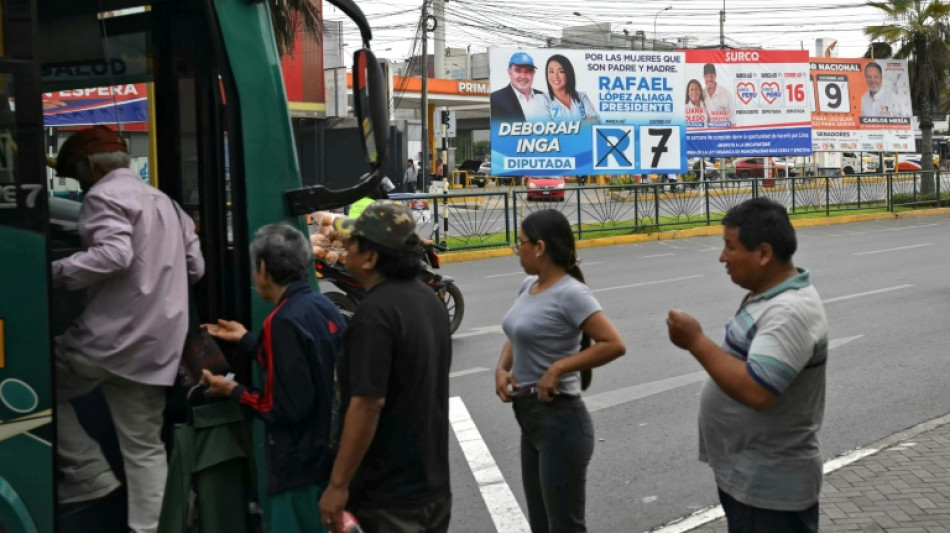
Also in the running is TV comedian Carlos Alvarez and Rafael Lopez Aliaga, a far-right ex-Lima mayor who has promised to "hunt" Venezuelans and refers to himself as "Porky".
Sociologist David Sulmont told AFP the elections show "a major disconnect" between the public and what politicians are offering.
Incumbent Jose Maria Balcazar, interim president for less than two months, is barred from running.
Polls open at 7:00am local time (noon GMT) at 5:00pm (2200 GMT) Church bells will ring, signaling the polls are closed and some religious sites will reopen.
The election will also decide the makeup of Peru's congress, which has been instrumental in removing several leaders from office.
I.Kai--HStB