'Fantastic feeling': Sudan capital returnees relieved after three years of war / Photo: Ebrahim Hamid - AFP
Sudanese pilot Mohamad Daafallah grins as he shakes hands with passengers after their landing at Khartoum Airport, exactly three years after it was bombed to shreds during the outbreak of war in Sudan.
The airport was one of the last footholds of the rival paramilitary Rapid Support Forces (RSF), where battles raged as the army launched an offensive last year to retake Khartoum.
A year after the army successfully recaptured the capital, authorities have refurbished a terminal to receive daily domestic flights from the Red Sea city of Port Sudan, allowing relieved residents to return home.
"It's a fantastic feeling, to bring people home, to have our country back," Daafallah told AFP, beaming with pride.
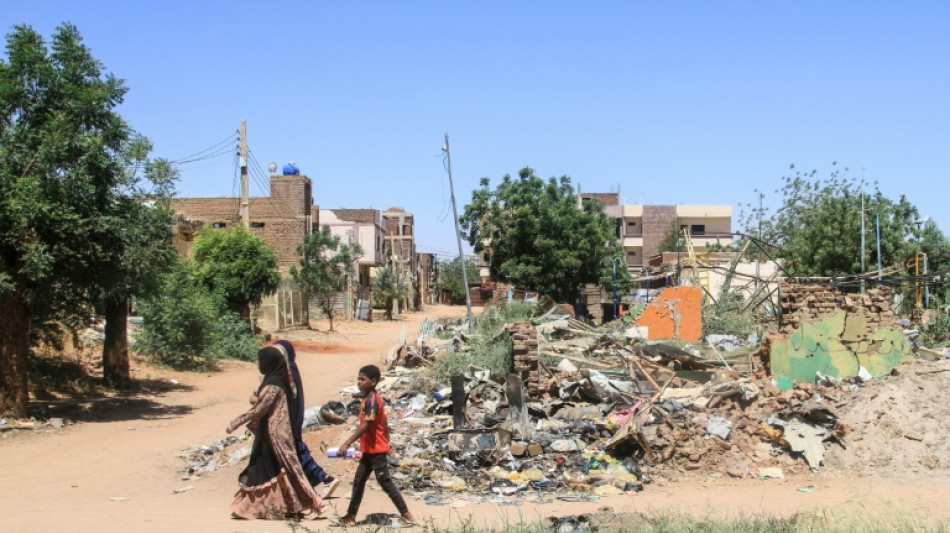
Khartoum's city centre, once home to bustling markets, towering businesses and wealthy districts, remains a ghost town, a mass grave and a minefield.
But despite decimated infrastructure, those coming back were overwhelmed by the thought of seeing their city for the first time in years.
"I'm just so exhausted, I want to be home," Bothaina, a septuagenarian poet dressed in a bright, flowing thobe, told AFP as the plane landed.
"I've wanted to be home for so long."
Behind her on the runway lie the remains of some bombed-out planes.
The airport's formerly charred and shattered terminals became symbols of the war when fighting broke out between the army and the RSF on April 15, 2023.
Port Sudan served as the government's wartime capital as fighting raged, but has since become a layover for those eager to find a way back to Khartoum with no international flights running.
"Every morning, the flight from Cairo basically unloads straight onto the flight to Khartoum," an airport worker told AFP.
- Ghost town -
Of the nearly four million people -- around half Khartoum's pre-war population -- who fled during the conflict, more than 1.8 million have returned over the past year.
Yet fewer than 80,000 people have come back to central Khartoum, according to the United Nations.
A quick drive through downtown Khartoum leaves little to the imagination.
The battles went street by street, first in April 2023 when the paramilitaries swept through town, and again last year when the army and allied fighters forced their way back.
Nearly every building taller than four storeys -- banks, government institutions and office blocks -- looks the same: every window shattered.
Soot covers the structures from floor to roof while bullet-riddled facades overwhelm the city.
The thin spines of minarets are pockmarked with bullet holes, leaving the sky visible through them.
Between the verdant banks of the Nile, a vital bridge connecting Khartoum with twin city Omdurman has its middle chunk missing, the result of an air strike to cut off the RSF.
Even as officials push a reconstruction agenda, thousands of explosives still litter Khartoum.
Mine clearance teams work every day, but the sheer scale left behind is more than they could handle in a year.
Reliable electricity and water services still haven't returned to much of the city.
- 'Toxic legacy' -
The UN Environment Programme warned on Wednesday that "stagnant pools of water and sewage have become breeding grounds for malaria-carrying mosquitoes".
A "toxic legacy" has been left in Khartoum, it said, "threatening to sicken and kill for years to come".
There is no confirmed death toll from the war, but authorities say more than 20,000 bodies have been exhumed and reburied in Khartoum.
Many were pulled from mass graves or makeshift cemeteries where families buried their loved ones while under siege, unable to give them a proper burial.
Even the living are hard to find. In much of the city centre, not a soul stirs, save for an odd soldier lounging underneath a tree, or a lone woman walking in the blazing sun.
In Omdurman, which remained relatively safe throughout the fighting, a semblance of normalcy has returned with workers sweeping the streets and commuters waiting for buses.
It is where many returnees are now headed, including Bothaina.
Even the few advertising billboards that dot Khartoum's streets -- those that don't commemorate the army's fallen soldiers -- are all about return.
A dairy company says "it's back for its people", while a flour milling company vows: "We're back, and stronger than before."
But while it was a relief to be home for returning Khartoum residents, some were still anxious after years of war.
"It's my first time back to Sudan in three years, I'm going to see my house for the first time," said government employee Tarek Abdallah, adjusting his suit jacket, his voice shaky with anticipation.
"But I'm still worried," he added, saying he would not uproot his teenage children to move back to the city, even as the government pushes for revival.
U.Kawena--HStB