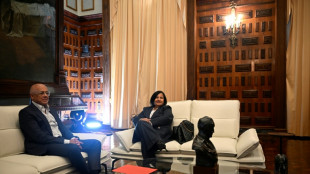


Romania's pro-European PM ousted in no confidence vote
Romania's pro-European Prime Minister Ilie Bolojan was ousted Tuesday in a no confidence motion brought by the Social Democrats, his estranged allies, and the far right, deepening political turmoil in the EU and NATO member bordering Ukraine.
The left-wing Social Democrats, the biggest party, were accused of legitimising extremist politics after they teamed up with the main far-right party AUR to bring down the coalition government.
The motion received 281 votes in the 464-seat parliament. Bolojan's liberals and his allies were present, but did not vote.
AUR leader George Simion posted on X after the vote that "the voice of the people was heard today" and called for "national reconciliation".
The Social Democrats quit the government last month in protest over unpopular austerity measures aimed at reducing the deficit, the biggest in the European Union.
The AUR has overtaken the Social Democrats in surveys since the last parliamentary elections, sitting at around 37 percent.
Pro-EU President Nicusor Dan has said the eastern European country of 19 million people will keep its pro-Western direction, ruling out a far-right government or early elections.
"We are beginning negotiations to form a new government," he said, calling for calm and insisting there was "consensus among the pro-Western parties on Romania's broad directions".
Social Democrat leader Sorin Grindeanu said after the vote that Bolojan should resign, and it was "the duty of responsible parties to find a solution".
"I want us to form a government quickly," he said.
- 'Cynical, contrived' motion -
In parliament ahead of the vote, Bolojan defended his push for reforms, slamming the motion as "deceitful, cynical, and contrived."
"I chose to do what was urgent and necessary for our country," he said.
According to law, after parliament adopts a motion of no confidence, the prime minister and ministers can remain in office until a new government is sworn in, but with limited powers.
Bolojan's liberals, the Social Democrats and two other pro-EU parties formed a government last year following elections in which the far right won an unprecedented third of parliamentary seats.
The deal ended political tumult marked by the annulment of presidential elections over allegations of Russian interference in December 2024.
The no-confidence motion against Bolojan now threatens to revive the turmoil.
- Financial turmoil -
Political scientist Costin Ciobanu told AFP the Social Democrats' move to join forces with AUR for the motion had turned the far-right party "into a significant political player, from a party that was isolated, ostracised and kept on the margins of the political system".
Ciobanu, a researcher at Aarhus University in Denmark, said weeks of political negotiations were likely, which could see a new government of the same four pro-EU parties but with a different prime minister.
"We're seeing this existential anxiety within the Social Democratic Party" which "doesn't know what it should do right now to get back to where it used to be", Ciobanu added.
Since the crisis erupted, the interest rates at which Romania borrows have risen, and the lei currency has depreciated against the euro, which reached an all-time high of 5.21 Romanian lei on Tuesday.
Romania, which had a deficit of 7.9 percent of GDP in the fourth quarter of last year, has been subject to an EU excessive deficit procedure since 2020.
F.Lono--HStB