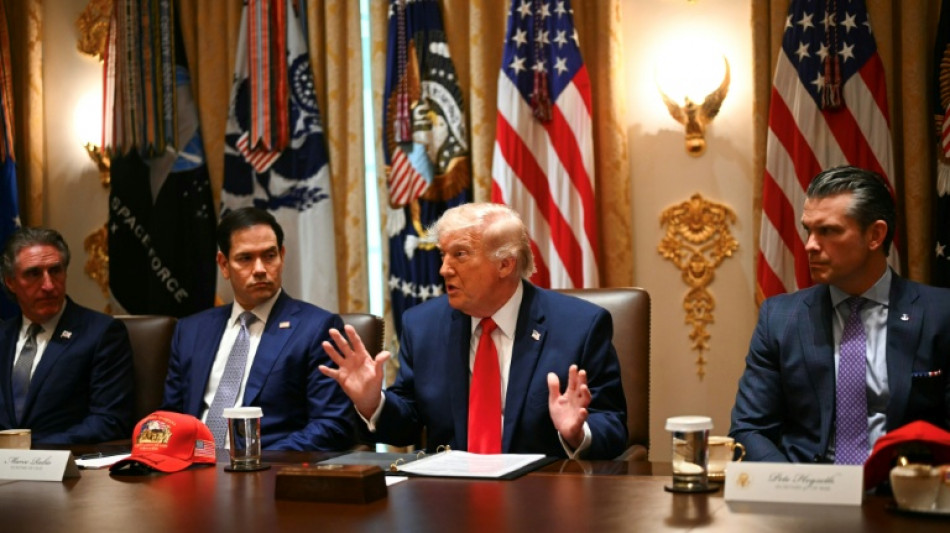
US, Iran agree deal framework but need Trump sign-off: sources / Photo: Kent NISHIMURA - AFP
US and Iranian negotiators have agreed on a framework for a 60-day ceasefire extension deal in the Middle East war but were still waiting for President Donald Trump's approval, US sources told AFP on Thursday.
The development came after Washington and Tehran accused each other of violating an ongoing truce following an exchange of fire, three months after the conflict began with US-Israeli strikes on the Islamic republic.
The sources confirmed reporting by the Axios news outlet that the two sides had reached an agreement on a memorandum of understanding to prolong the truce and launch negotiations on Iran's nuclear programme.
The provisional agreement is significant as it arrived just days after the most serious trading of fire since the ceasefire started in April, rattling ongoing diplomatic efforts to end the war.
The clash had also drawn in US ally Kuwait, which accused Iran of a "dangerous escalation".
US strikes on the southern Iranian port city of Bandar Abbas prompted Iran to target "the American airbase that served as the source of the attack", according to state broadcaster IRIB, citing the country's Revolutionary Guards.
The Guards did not specify the location, but Kuwait, which hosts US troops, said its air defences had responded to incoming fire.
Its foreign ministry later condemned "the criminal Iranian attacks that targeted the territory of the State of Kuwait with missiles and drones, in a dangerous escalation".
The US Central Command called the attack an "egregious ceasefire violation".
Iranian forces had fired at four ships attempting to transit the Strait of Hormuz without authorisation, IRIB reported on Thursday. Iran has blockaded the waterway since the war began on February 28.
US forces said they had intercepted five attack drones in and around the strait, and prevented the launch of a sixth from a ground control station in the Bandar Abbas area.
Iranian foreign ministry spokesman Esmaeil Baqaei said Iran would "take all necessary measures to defend its national sovereignty", likewise describing the US strikes as truce "violations".
A US official told AFP the actions had been "measured" and "intended to preserve the ceasefire".
Iran's Guards threatened a "firm response" on Thursday in the event of renewed attacks.
- Hormuz impasse -
Before Thursday's strikes, Amir, a 27-year-old software developer in Tehran, said fears of renewed fighting were ever present in spite of the ceasefire and talk of a deal.
"I feel like nothing is certain yet," he said. "The daily question is: Will there be missile strikes tonight?"
A key focus of the proposed deal has been restoring full traffic in the Strait of Hormuz, whose closure has global energy markets grappling with curbed supplies of the huge amounts of oil and gas that normally pass through it.
Oil prices bounced higher on Thursday after reports of the strikes, reversing much of the previous day's fall spurred by hopes of a deal.
Trump threatened US ally Oman when asked about a possible short-term arrangement allowing it and Iran to control the strait.
"No, the strait is going to be open to everybody," Trump said. "It's international waters and Oman will behave just like everybody else or we'll have to blow them up."
US Treasury Secretary Scott Bessent on Thursday also threatened to "aggressively target" Oman if it helped impose a tolling system in the strait.
Oman mediated US-Iran talks in Geneva before the war, and has itself come under attack from Tehran. Pakistan has since taken on a lead mediating role in the peace efforts.
Baqaei called the threat towards Oman "a worrying sign of the normalisation of anarchy and intimidation in international relations".
- Lebanon strikes -
In Lebanon, a separate ceasefire has done little to stop the fighting between Israel and Iran-backed Hezbollah, which has only escalated.
Iran has insisted any agreement to end the war must apply to Lebanon.
Israel's military said Thursday it had conducted a precise strike in the area of Beirut, with the Lebanese military saying the attack hit an apartment south of the capital.
AFPTV footage showed smoke rising from the area on the edge of Beirut's southern suburbs, a Hezbollah stronghold.
Lebanese authorities said Thursday Israeli attacks in the south had killed at least 14 people, including three children and a soldier.
The previous day Israel had declared most of south Lebanon "combat zones" and told residents to leave.
Lebanon's health ministry on Wednesday reported the overall death toll stood at 3,269 since the start of the war.
The Israeli military said Thursday a soldier was killed the day before by a Hezbollah drone near the Lebanon border. Twenty-three Israeli troops and one civilian contractor have been killed in the war so far.
J.Manu--HStB