Iran fans dismayed by team's World Cup visa quarrel / Photo: Guillermo Arias - AFP
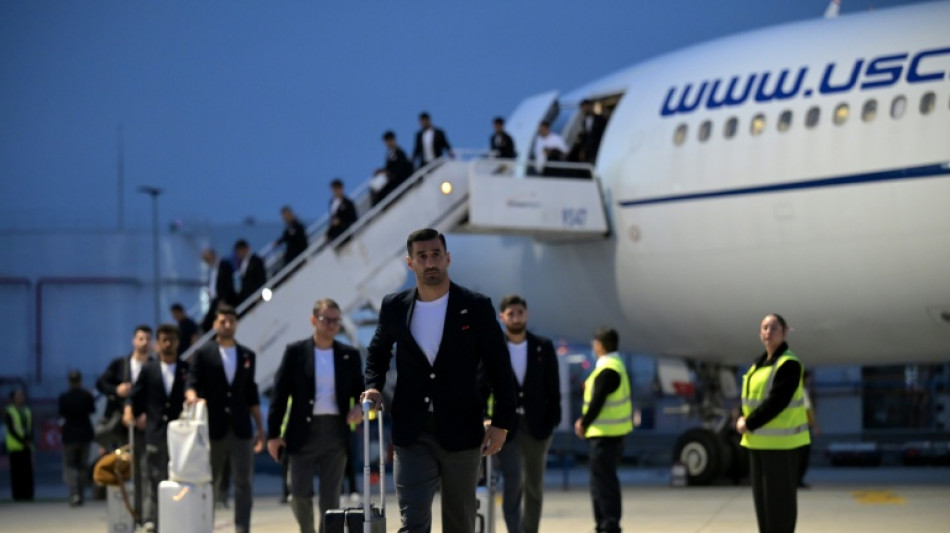
Iran's national football team was greeted Sunday in Mexico by a small group of supporters eager to give them a warm start to the World Cup, despite visa problems facing some staffers.
"I'm very excited to see them," said Sadegh Galavi as he watched the players' bus leave the airport in Tijuana, cheered on by about a dozen fans.
Galavi, a mechanic and resident of this city on the US border, did not hesitate to get up at dawn to welcome the team when it landed at 5:00 am.
"My national team is coming to my city, and being here is a small thing I can do just to welcome them," the man in his thirties told AFP, proudly wearing the white jersey with green and red trim of the Iranian side, known as "Team Melli."
The gesture felt especially important because the tournament is beginning under difficult circumstances for Iran.
While the players obtained the visas necessary to enter the United States and play their group-stage matches in Los Angeles and Seattle, not all delegation members received them.
About 15 accompanying officials were denied visas, including Iranian football federation president Mehdi Taj, who previously served in Iran's Islamic Revolutionary Guard Corps, designated a terrorist group by Washington.
- Unshakable faith -
"It makes no sense to me," Galavi complained. "Sport is supposed to be a symbol of peace, so when you mix politics and sports, it doesn't work."
The visa controversy is the latest chapter in the drama surrounding Iran's team at this unusual World Cup, jointly hosted by the United States, Mexico and Canada.
Since the first Israeli and American strikes against Iran in late February, the war has created repeated uncertainty over Team Melli's participation.
Never before had a nation competing in the tournament been at war with one of the host countries, and Tehran long left open the question of whether its team would be allowed to play.
The insistence of FIFA ultimately prevailed. But two weeks ago, rising tensions prompted the Iranian federation to announce that the team would stay in Tijuana rather than in Tucson, Arizona, as originally planned.
With all these off-field developments, can the Iranians play their best football against New Zealand, Belgium and Egypt and finally advance from the group stage -- a feat they have never achieved?
Sina Moghadam has no doubts, and displays unwavering faith in his team.
"Iran's history goes back thousands of years. Things like this only make us stronger; they won't destabilize the team," boasted the Iranian-American, who had traveled from San Diego, just across the border in California.
- Lack of 'Fair Play' -
Waving an enormous Iranian flag, the retired self-described "patriot" said he was hoping for a match between Iran and the United States in the knockout stage -- a blockbuster encounter that would become the political spectacle of the tournament.
"I hope they're going to kick the US team's ass," he laughed as the players' bus disappeared from view.
Escorted by a large convoy of heavily-armed Mexican police and military personnel, the team arrived to find extensive security measures around its hotel as well as at the entrance to Estadio Caliente, where Iran is scheduled to train.
The security presence offered some reassurance to Hossein Nikyar, who had driven overnight from Los Angeles with his son to herald the team's arrival.
"It's safer for them to be here than in Los Angeles anyway, because many Iranians in LA are royalists who want to take down the government," said the engineer in his forties.
Nikyar already has tickets to see Iran play in Los Angeles. But even before the tournament begins, he cannot hide his bitterness.
"FIFA claims that there's no politics in the World Cup, and it's all about the football fair play," he sighed.
"But in fact, we see that it's not true."
O.Wailani--HStB