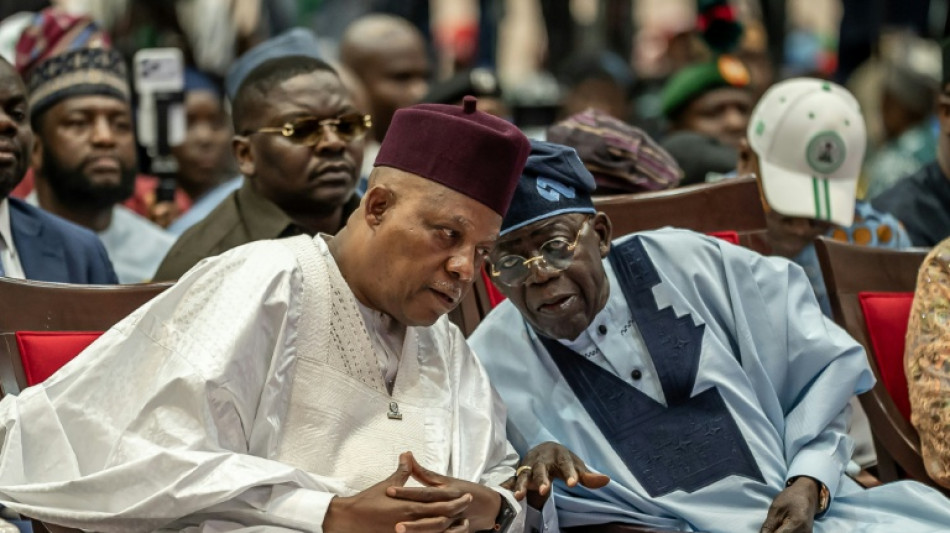
Major Nigeria police reform edges forward with senate approval / Photo: Light Oriye Tamunotonye - AFP
The Nigerian Senate on Wednesday approved a bill to allow states to create their own police forces, following lower chamber passage earlier this month of what could be a potentially sweeping security reform.
Critics of the highly centralised federal police force say it has been unable to tackle the country's myriad conflicts -- concerns brought back into the spotlight recently after a mass school abduction in the typically safer southwest.
But experts warn that putting Nigeria's 36 states in control of their own police could embolden the country's powerful governors in a nation where politics is already often violent.
The version of the reform passed by the Senate will likely need to be harmonised with that passed by the House of Representatives two weeks ago. As a constitutional amendment, it will also require approval by two-thirds of Nigeria's state-level houses of assembly.
President Bola Tinubu has backed the reform as insecurity roils Nigeria ahead of January elections in which he is seeking a second term.
Nigeria's police and military have long been overstretched: across its north, Africa's most populous country is fighting a long-running jihadist insurgency, complicated by inroads made by militants from the Sahel, and non-ideological "bandit" gangs.
The centre of the country is the scene of farmer-herder violence, while the southeast is home to a low-level separatist conflict.
- Police to 'fill gaps' -
Supporters of the reform say it would create nimble police forces that are more easily held accountable and staffed by locals who know the terrain.
For years already, states have backed locally recruited militias to plug gaps left by the military and police.
State police "would help fill the yawning gaps in extant policing framework," Femi Mimiko, a political science professor at Obafemi Awolowo University, told AFP.
But Usman Ibrahim, director of security programmes at SARI Global, a risk consultancy, warned that complex economic and political factors beyond a simple lack of security have sustained armed groups in Nigeria.
"Is it something that state police can solve?" he asked.
There are also fears governors will deploy state police to intimidate opposition parties, interfere with elections and harass critics, said Dengiyefa Angalapu, a research analyst at the non-profit Centre for Democracy and Development.
Already, the federal police are routinely accused of interfering in politics on behalf of the national government, he noted.
As the reform gathers steam, it remains unclear how state and federal police would settle disputes over jurisdiction -- and whether the creation of yet another security organ would actually make a difference.
Despite Tinubu's inauguration of Nigeria's Forest Guards service, for example, kidnappings have continued unabated across the country -- with some 900 incidents recorded this year, according to conflict tracker ACLED.
A.Kalani--HStB