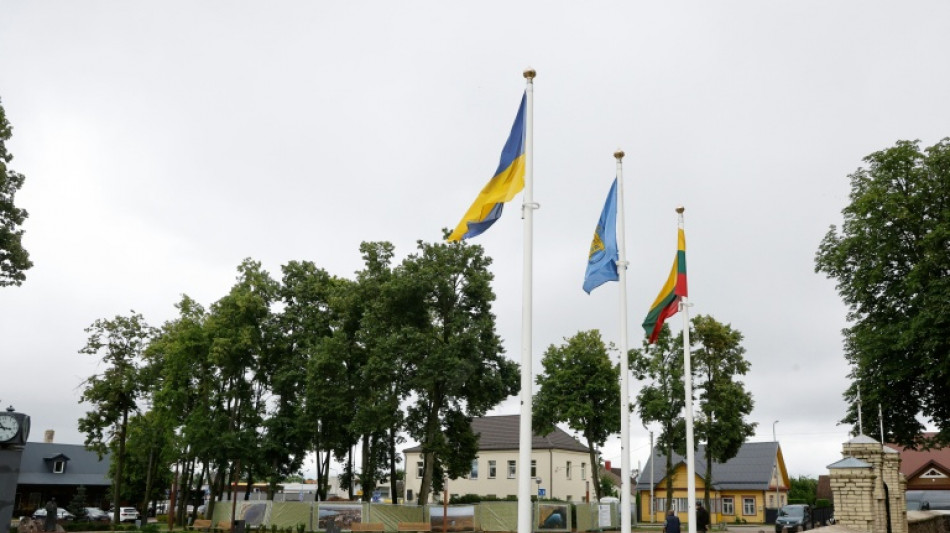
Lithuania moves Red Army graves to leave behind Soviet past / Photo: Petras MALUKAS - AFP

A wartime grave-site outside Lithuania's capital has become the stage for a political skirmish with Russia, as the Baltic country works to shed the last remnants of Soviet occupation.
Sifting through layers of clay-coloured soil, archeologists in Vievis, west of Vilnius, carefully uncover the bones of Red Army soldiers at one of the many memorial sites installed by Moscow in the wake of the Second World War.
Lithuania removed most Soviet monuments shortly after regaining independence in 1990, but it was not until the full-scale Russian invasion of Ukraine in 2022 that Kyiv's close ally Vilnius opted to move the graves -- which many saw as the last visible symbols of USSR domination.
"The memorial site served a propaganda purpose," Tadas Simonauskas, the chief archaeologist on site, told AFP as his team conducted the excavations.
Among the bones, the twisted remains of a gas pipe were the only remnant of an eternal flame installed by the Soviets to memorialise what Moscow still refers to as the "Great Patriotic War".
Used to describe one of World War Two's most significant chapters, as the Allies battled Nazi Germany on the Eastern Front, the term has been rejected by many post-Soviet countries as a distortion of the realities of occupation.
"The memorial stood here to remind us that we were supposedly 'liberated' by the Soviets," Petras Martisius, a local pensioner passing by the dig site, told AFP.
"They should have been moved earlier."
- 'De-Sovietisation' -
Now an EU and NATO member state, Lithuania -- which borders Russia and its ally, Belarus -- fears that it risks being invaded next as the war in Ukraine drags on into its fifth year.
It was shortly after the start of the war that the Lithuanian parliament passed the so-called "de-Sovietisation" law, paving the way for the removal of the last Soviet monuments and the relocation of the graves.
At the time, there were 157 burial sites of World War II-era Soviet soldiers in the country's cultural heritage register.
Vilnius has revoked four of the sites' protected status -- a measure put in place initially to prevent Russia from altering them without the state's approval.
At some sites Russians changed plaques, upping the number of buried soldiers, according to Rita Kunceviciene, who is responsible for heritage objects at the Lithuanian Culture Ministry.
"The more troops have died, the more (Moscow) can say that Lithuanians do not honour their 'liberators'," she added.
Lithuania first began relocating the Soviet graves from the small northern town of Pumpenai in July 2023, followed by the northern city of Siauliai in April this year and the town of Vievis earlier in July.
Moscow was incensed by these excavations, branding them an attempt to rewrite history, and summoned Lithuania's envoy several times to protest what it called a "barbaric plan".
The Kremlin is now preparing for an international court battle over alleged discrimination against ethnic Russians, according to a recent report by Baltic investigative journalists.
The relocation of Soviet graves could reportedly become part of the case.
"Russia is using the international arena as a way to spread its narrative that the Baltic states support nazism and discriminate against ethnic Russian minorities," said Indre Makaraityte, an investigative reporter at Lithuania's public broadcaster, LRT.
- 'Marks of their existence' -
Following the relocations, Russia accused Lithuania -- and the other Baltic states of Estonia and Latvia, which took similar steps -- of discriminating against Russian culture and committing a crime under Russian law.
Before that, Lithuania protested the recent destruction of monuments to the tens of thousands of people deported to Siberia, as well as Baltic and Polish victims of Stalinist atrocities.
The relocation of the remains –- which will be reburied at a nearby Orthodox cemetery -- are permitted under international law, the Lithuanian foreign ministry said in a statement to AFP.
Article 17 of the First Geneva Convention stipulates measures "to allow subsequent exhumations and to ensure the identification of bodies, whatever the site of the graves" and the possible repatriation of remains.
In the church grounds next to the Red Army burial site in Vievis, the grave of a Lithuanian priest shows he had been sent to Stalin's Gulags in 1950 –- around the same time the Soviet monument was erected nearby.
"This was merely a Soviet symbol marking their territory, that they are controlling us," Vaidas Andriejauskas from the local Elektrenai municipality, which is overseeing the process, told AFP.
"We will rebuild a small monument for the soldiers at the cemetery -- we are not destroying marks of their existence."
C.Keone--HStB