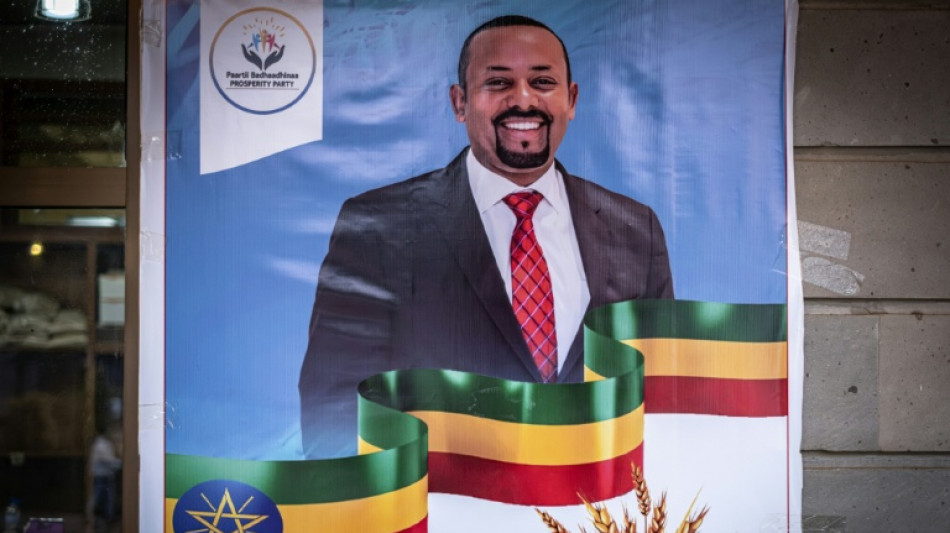
Ethiopia's Abiy could consolidate power as 'executive president' / Photo: Marco Simoncelli - AFP

A weeks-long political dialogue in Ethiopia has backed constitutional changes to create a new presidential system that could extend Prime Minister Abiy Ahmed's control over the country.
Abiy, 50, has ruled the Horn of Africa country of 130 million since 2018.
His party won another landslide victory at elections in June, albeit in the midst of a crackdown on the opposition and media.
That was followed by a long-promised "national dialogue", in which some 4,000 delegates gathered to discuss the country's many challenges, including its deep ethnic divides and ongoing insurgencies.
More than a month of talks ended on August 22 with the delegates overwhelmingly backing plans to combine the office of prime minister and the largely ceremonial presidency into a new "executive presidency".
It could be put before parliament as soon as it reconvenes in October.
Most assume that Abiy, who was absent from the dialogue, will get the job if it goes ahead, since this new president will be selected by a parliament packed with his supporters.
They say it will be a more unifying role, representing all of Ethiopia's ethnic groups, compared to the current system in which Abiy is elected as a member of parliament from his Oromia region.
It will create "a more unified country to overcome the challenges the country currently faces", said Tiglu Melese, secretary-general of parliament's upper house.
The dialogue also recommended that funding be cut to ethnic-based parties in favour of "national" ones.
Critics fear all this will allow Abiy to consolidate personal power, as Turkey's Recep Tayyip Erdogan did when he jumped from prime minister to a newly created executive presidency in 2014.
"It would only allow the current prime minister to assume the executive presidency while effectively concentrating power in a single individual," said political analyst Befekadu Hailu.
- Seeking peace -
Ethiopia faces deep ethnic divides, with armed conflicts ongoing in its two most populous states, Oromia and Amhara, and fears that the 2020-2022 civil war in the northern Tigray region -- which killed an estimated 600,000 people -- may reignite at any moment.
Critics say the dialogue -- which excluded armed groups and was boycotted by key opposition parties -- did little to address these challenges.
"It cannot ensure the two greatest needs of the country: durable peace and stability, and democratic governance," said Merera Gudina, chairman of the Caucus of Opposition Parties, which stayed away from the dialogue.
The recommendations "should be complemented by peace negotiations between the government and the armed groups and opposition political parties to silence the guns", added Naga Tesfaye, a peace-building expert who served as a facilitator of the dialogue.
Some debates proved highly contentious.
There were multiple walkouts over the status of the self-governing capital, Addis Ababa, which the surrounding Oromia claims as its own.
But some participants welcomed the dialogue as a rare instance of open debate in a country accustomed to authoritarian rule.
"Bringing together groups with contending understandings of the Ethiopian state, for the first time ever, itself has been a successful exercise," said Alamrew Yirdaw, a participant from the Amhara region.
Hirut Gebreselassie, deputy chief of the dialogue commission, told AFP: "I hope the contending issues concerning the Ethiopian state are gradually resolved, mutual suspicion among people is reduced, and peace is incrementally maintained as a result of the dialogue process."
S.Halia--HStB