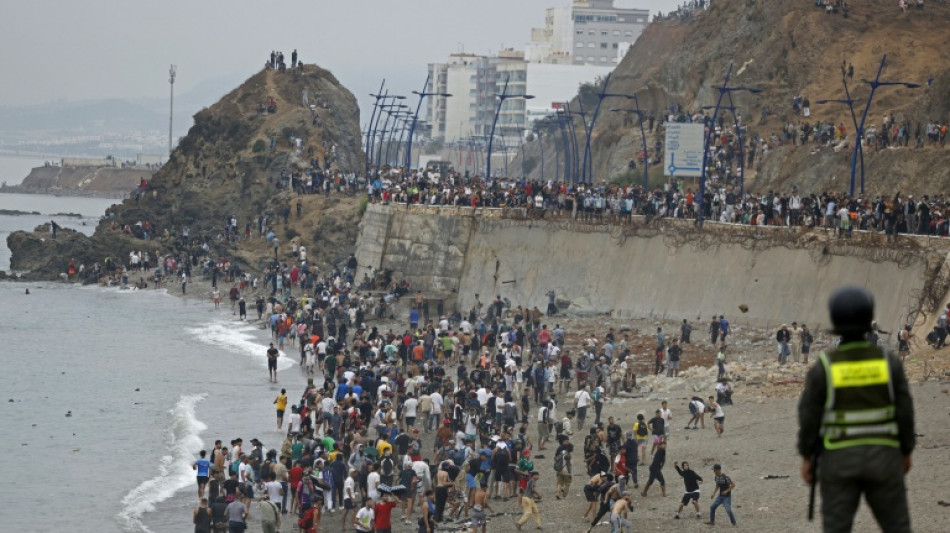
Spain report flags Moroccan police failings in Ceuta migrant rush / Photo: Abdel Majid BZIOUAT - AFP
Moroccan security forces displayed "total permissiveness" during the unprecedented migrant rush into Spain's north African territory of Ceuta in July, according to a Spanish police report seen by AFP on Wednesday.
The findings risk embarrassing Spain's leftist government, which has avoided blaming Morocco for the crisis and striven to improve delicate relations with Rabat.
More than 70,000 migrants crossed into Ceuta from Morocco on July 30 and 31 in a surge that left scores dead, most by drowning as they tried to swim around a breakwater.
A report by the Spanish police's National Centre for Immigration and Borders (CENIF) said "the Moroccan police response... was one of total permissiveness to say the least".
Moroccan police made "no serious attempt to try to reduce, disperse or move the mass of people away from the border perimeter", the report said.
Statements by "a large sample of immigrants" who entered Ceuta spoke of a police presence around the border that "was clearly smaller than usual", the report added.
Satellite images from July 30 show no police or military forces deployed at the beach or the breakwater where the migrants entered, nor on the surrounding roads and roundabouts, the report said.
Migrants interviewed as part of the investigation said "practically unanimously that the police officers did not only remain in a passive attitude in the face of the attempted entries, but they offered instructions to allow them to enter by water".
The report also mentioned "non-uniformed individuals" who were "managers of the process, monitoring in some cases, driving and directing in others, the mass of people towards" the breakwater.
- Denial -
The chaotic crossing into Ceuta sparked European Union infighting over the touchy issue of migration.
A few days after the influx, a Moroccan source close to the case denied to AFP any "relaxation" at the land border crossing.
The Moroccan interior ministry has blamed the sudden surge on the "malicious exploitation" of social media and the "spread of misleading information".
The Spanish interior ministry released a series of statements throughout Wednesday denying that any police report highlighted Morocco's responsibility, after right-leaning online newspaper El Espanol first reported on the CENIF's findings.
A series of communications among Spain's top police officers amid the revelations "does not make it possible to establish the involvement of any government, service, agency or person", a ministry statement said.
Socialist Prime Minister Pedro Sanchez ruled out Moroccan responsibility on Monday, instead highlighting the importance of cooperation with Rabat, which has since taken back most of the migrants.
The right-wing opposition has fiercely criticised his handling of the crisis and have consistently raised questions over the role played by Morocco.
Ceuta and Spain's other north African enclave, Melilla, have the European Union's only land borders with Africa, and their status has historically poisoned relations between Madrid and Rabat.
Morocco claims sovereignty over both territories, while some analysts have suggested it used the migrant rush to exert political pressure on Spain after Sanchez visited Rabat's historic enemy Algeria in July.
The disputed Western Sahara is a source of tension between the countries, with Morocco largely controlling the former Spanish colony that is claimed by the Algerian-backed pro-independence Polisario Front.
O.Wailani--HStB