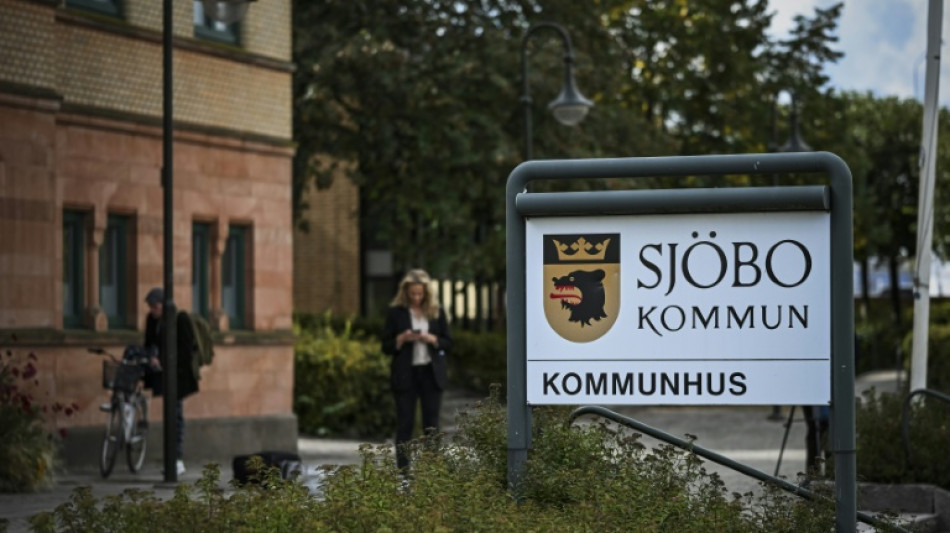
Sjobo, cradle of Sweden's now-mainstream anti-migrant sentiment / Photo: Jonathan NACKSTRAND - AFP


Almost 40 years ago, two-thirds of residents in Sweden's Sjobo municipality voted against welcoming refugees. The stance sparked controversy, but has now become mainstream, resonating with many Swedes ahead of Sunday's general election.
"In the end, Sjobo residents were right, if you want to put it that way," 89-year-old pensioner Bengt Lundgren, who plans to vote for the far-right Sweden Democrats on Sunday, told AFP with a broad grin.
A key ally providing parliamentary support to Sweden's minority rightwing coalition, the Sweden Democrats are polling second nationwide in the final days before the election.
The party won 43 percent of votes in Sjobo in the 2022 general election, still enjoying strong support in the southern town known for its contentious September 1988 referendum.
In 1987, Sweden adopted a new strategy to distribute refugees more evenly across the country, and asked Sjobo, then a town of around 15,400, to take in around 15 people.
The question swiftly sparked a heated clash between those in favour and those against.
"Anyone can understand that the next generation of Swedes will no longer be blonde and blue-eyed," Sven-Olle Olsson, a municipal councillor who was vehemently opposed, said at the time.
He organised a referendum on the issue.
The decision to hold a vote -- unheard of in Sweden, long a haven for the persecuted and war-weary -- made headlines, and an avalanche of journalists, both domestic and foreign, descended on the small town.
- No more parties -
The referendum forged a deep divide among residents.
"There was a place here where they used to hold town parties. And it wasn't possible anymore, because you couldn't party with someone who was in the 'Yes' camp when the others were on the 'No' side," recalled Charlotte Ramel, speaking to AFP at the town hall
Her mother, who was on the municipal council at the time, was the leader of the 'Yes' camp.
That stance made her the target of numerous threats, and her home was vandalised.
The 'No' side won the referendum with almost 68 percent of votes, triggering a political storm in the country.
Things have changed "enormously" since then, according to Ramel, now a municipal councillor herself who is trying to change Sjobo's image.
She said the municipality now fulfils its requirements by welcoming new arrivals, even taking in more than some other towns in the region.
Over the past decade, views on immigration have shifted dramatically across the entire country, as Sweden struggles to integrate its immigrants.
Around 20 percent of its population is born abroad, according to 2025 data from Statistics Sweden.
Since the 2015 migrant crisis that saw Sweden take in large numbers of asylum seekers, successive left- and right-wing governments have cracked down on immigration.
The right-wing minority government in power since 2022 has cut numbers even further, after reaching an unprecedented agreement with the far right giving it significant influence over government policy in exchange for its support.
Jimmie Akesson, the leader of the Sweden Democrats who hails from the same region as Sjobo, has therefore been able to impose his political agenda, with reducing immigration his top priority.
The party's focus is now on the "re-migration" of immigrants, either deporting them or giving them incentives to return to their home countries.
According to a report published this year by the Swedish Institute for Futures Studies, around half of Swedes want fewer refugees.
Public opinion remains in favour of labour immigration.
- 'Good politics' -
Edmir Mehmeti, a 24-year-old originally from Sjobo, is standing as a candidate for the conservative Moderate Party, the party of Prime Minister Ulf Kristersson, on Sunday.
He's in favour of a restrictive immigration policy.
When his family arrived from Kosovo in 1998, they struggled.
Sven-Olle Olsson, the organiser of the anti-refugee referendum, had tried to prevent them from settling in Sjobo.
He called their landlord to persuade him not to rent them the apartment, portraying them as a troublesome family, recalled Mehmeti.
One morning, the family woke to find a swastika painted on their car.
His own family's story seems to have had no bearing on his view on immigration.
"Today in Sweden, to say that we need lower migration, and maybe we need to deport more people, that's not controversial. That's quite honestly, quite good politics."
Y.Kapu--HStB