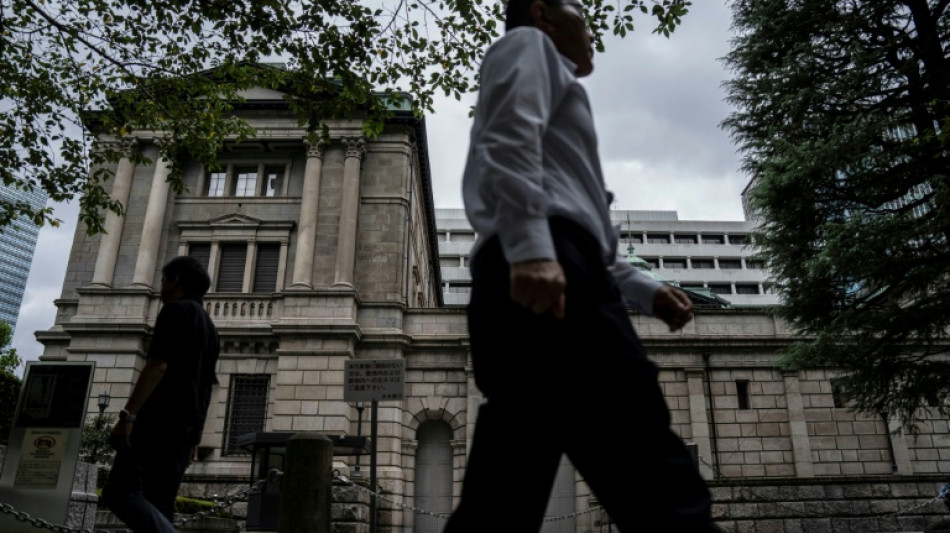
Stock markets diverge after central bank rate hikes / Photo: Yuichi YAMAZAKI - AFP



Global stock markets diverged and oil prices fell on Friday approaching the end of a week dominated by central bank moves to tame inflation driven by the Middle East war.
European markets fell while Asian equities were lifted by renewed AI optimism.
The Bank of Japan raised interest rates to a three-decade high on Friday, though the yen sank against the dollar on fears the pace of hikes might be slower than expected.
That came after the US Federal Reserve lifted borrowing costs, providing relief to traders concerned that policymakers were not moving quickly enough to address a spike in inflation that could deal a blow to the world's biggest economy.
The European Central Bank has also recently tightened monetary policy, while the Bank of England this week held its benchmark interest rate but signalled possible hikes ahead.
Oil prices fell around two percent on hopes that Saudi Arabia was moving to restore about half of crude shipments within days after they were disrupted by the stoppage of its East-West pipeline to the Red Sea.
The conduit, even more important since the effective closure of the Strait of Hormuz by Iran, was shut last week after being targeted by Yemen's Iran-backed Houthis.
Crude prices, which soared around a fifth in September, have fallen over the past three days, but international benchmark Brent remains over $100 a barrel.
The surge in oil has been among the main catalysts for rising inflation since the United States and Israel began their war on Iran at the end of February.
"Revived hopes for a resolution to the crisis in the Middle East have helped sustain a recovery in global equities but European stocks took a pause for breath on Friday," said AJ Bell investment director Russ Mould.
London, Paris and Frankfurt all dipped on Friday.
Chipmakers were the main beneficiaries of a return to AI optimism after a sell-off at the start of the week, as industry leaders called for slower development of the technology.
In Asia, Seoul, Tokyo, Hong Kong and Shanghai all advanced.
The latest moves in oil and the Fed's action kept the 10-year US Treasury bond yield, a key indicator of borrowing costs throughout the world's biggest economy, back below five percent.
Japan's Nikkei was also helped by a drop in the yen against the dollar that came in the wake of the Bank of Japan's well-telegraphed decision to lift rates to their highest level since 1995.
The yen slipped to more than 157 to the greenback, compared with around 156 earlier.
The fall in the Japanese currency came after "two committee members voted against the hike, which suggests the BoJ will not be able to embark on a fast pace of rate hikes", said Kathleen Brooks, research director at XTB.
- Key figures at around 1115 GMT -
London - FTSE 100: DOWN 0.9 percent at 10,718.68 points
Paris - CAC 40: DOWN 0.9 percent at 8,111.13
Frankfurt - DAX: DOWN 0.9 percent at 25,499.17
Tokyo - Nikkei 225: UP 1.4 percent at 65,018.95 (close)
Hong Kong - Hang Seng Index: UP 0.6 percent at 24,750.78 (close)
Shanghai - Composite: UP 0.9 percent at 3,911.87 (close)
New York - Dow: UP 0.6 percent at 51,778.04 (close)
Dollar/yen: UP at 157.79 yen from 155.96 yen on Thursday
Euro/dollar: DOWN at $1.1470 from $1.1480
Pound/dollar: UP at $1.3359 from $1.3358
Euro/pound: DOWN at 85.87 pence from 85.94 pence
West Texas Intermediate: DOWN 1.5 percent at $100.95 per barrel
Brent North Sea Crude: DOWN 1.5 percent at $103.39 per barrel
I.Kai--HStB