Papua New Guinea PM Tells Xi Closing Taiwan Office Was Not Easy
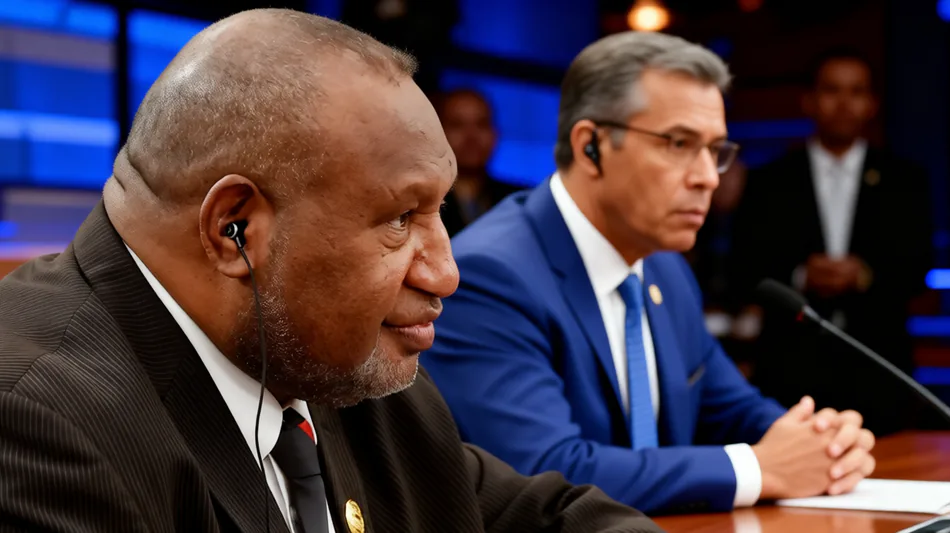
Papua New Guinea’s Prime Minister James Marape told Chinese President Xi Jinping on Tuesday that closing Taiwan’s representative office in his country was a difficult decision driven by internal political pressures. The admission comes as Papua New Guinea formally aligns with Beijing’s one-China policy, marking another shift in the diplomatic landscape of the Pacific region.
Papua New Guinea Prime Minister James Marape informed Chinese President Xi Jinping that ending diplomatic relations with Taiwan involved significant internal political pressures, acknowledging the decision was not easy to implement. The admission was made ahead of the APEC summit in Shenzhen, where Mr. Marape sought to demonstrate his government’s commitment to Beijing’s core foreign policy requirement.
Speaking to President Xi, Mr. Marape highlighted the domestic difficulties he faced in severing ties with Taipei. "Mr. President, if you want to appreciate Papua New Guinea's effort in acknowledging the fullest integrity of China in the effort to close Taiwan, it wasn't easy," he said. He added that he "faced challenges from within" because his nation maintains relationships with many other countries, but emphasized that his government remained resolved in its new alignment.
The diplomatic shift follows an announcement by Taipei in early November that it had decided to shut its representative office in Papua New Guinea and cease purchasing liquefied natural gas from the country. Taiwan attributed these moves to pressure exerted by Beijing. Papua New Guinea had briefly maintained diplomatic relations with Taipei in 1999 before restoring ties with China, which claims sovereignty over the democratically governed island.
In his address to President Xi, Mr. Marape stated, "We hope this assists you in your efforts for reunification ... because when Chinese prosper, we all prosper together." He also urged mutual respect for sovereignty, telling the Chinese leader, "China respects the sovereignty of Papua New Guinea. We must give full respect for the sovereignty of China."
The diplomatic realignment occurs against a backdrop of heightened regional tension. Recently, authorities in Port Moresby arrested four Chinese nationals after a large military-grade shell was discovered at a construction site. The object, weighing 32kg, was found inside a shipping container. Beijing dismissed the find as a "shell-shaped wine bottle," claiming its strict firearm control laws made smuggling illegal military equipment virtually impossible.
However, Australia’s ABC broadcaster reported that the object was an undetonated 130mm Chinese Type 59 artillery projectile containing chemical explosives and a fuse. The US embassy in Port Moresby confirmed it had directly engaged with Papua New Guinea’s explosive ordnance disposal unit regarding the examination of the suspected shell.
Taiwan’s withdrawal from Papua New Guinea reduces the number of countries maintaining formal diplomatic ties with Taipei to just 12 globally. The island nation retains formal relations only with Palau, Tuvalu, and the Marshall Islands in the Pacific, alongside a representative office in Fiji. The United States, Taiwan’s primary international partner and arms supplier despite lacking formal diplomatic ties, expressed concern over the closure.
The US State Department described the move as "yet another example of Beijing's intimidation campaign against Taiwan and its supporters around the world." President Xi responded to Mr. Marape by thanking him for Papua New Guinea’s active development of relations with China and its firm adherence to the one-China principle.
W.Kalua--HStB