How a Brazilian Journalist Helped Save an Uruguayan Dissident from Operation Condor
In November 1978, Uruguayan political exile Lilián Celiberti was abducted in Brazil by agents from both Brazilian and Uruguayan security forces as part of the transnational repression network known as Operation Condor. Facing imminent enforced disappearance, Celiberti orchestrated a desperate plan to contact the press, resulting in a tense standoff that ultimately drew international attention to her case and likely saved her life.
Fifty years after the formalization of a secret pact among South American military regimes, newly released documents and testimonies detail how Uruguayan political exile Lilián Celiberti narrowly avoided enforced disappearance through a calculated appeal to the press. The files, published as part of a special series marking the 50th anniversary of the Operation Condor agreement, reveal that Celiberti’s abduction in Brazil in 1978 was not an isolated incident but a coordinated act of transnational repression.
The narrative centers on events beginning November 12, 1978, when Celiberti was waiting for relatives at a bus terminal in Porto Alegre, Brazil. Officials approached her for identification, and upon her protest, escorted her to a private room. There, she encountered a soldier from her time as a political prisoner in Uruguay. Brazilian and Uruguayan officials then bundled her into a car and transported her to a police station.
“It’s terrifying,” Celiberti recalled later. “You ask yourself, ‘How am I going to get out of this?’”
At the time, neither Celiberti nor her family understood that her abduction was part of a broader strategy. In November 1975, intelligence chiefs from Argentina, Bolivia, Chile, Paraguay, and Uruguay had met in Santiago, Chile, to coordinate the hunting down of political dissidents across borders. The agreement signed on November 28, 1975, became known as Operation Condor. Brazil joined the pact in 1976, followed by Ecuador and Peru in 1978. The United States provided significant financing and support to these military regimes.
Celiberti’s ordeal began immediately upon her arrival at the Porto Alegre police station. Stripped of her belongings, she was subjected to torture via electric shocks while interrogators questioned her political activities. During this process, an officer entered with a document Celiberti realized she had inadvertently carried: a paper containing her family’s home address.
The revelation triggered immediate fear for her husband, Universindo Rodríguez, and their two young children, Francesca and Camilo. Brazilian military commanders, who had seized power in 1964, had maintained a dictatorship for 14 years by 1978. The regime had kidnapped and tortured thousands of dissidents and was responsible for the forced disappearance or murder of over 400 people.
However, the political climate in Brazil was shifting. Responding to pressure from civil society, the Brazilian government was attempting to reduce the visibility of its abuses, contrasting with the more savage repression occurring in neighboring Argentina, Chile, and Uruguay. For the Brazilian officers involved in Celiberti’s abduction, this meant operating without the same degree of legal sanction as their Uruguayan counterparts.
“The Uruguayan military wasn’t accountable to anyone, but in Brazil this was a clandestine operation; it wasn’t an official operation by [the dictatorship’s secret police],” Celiberti stated. “It was an operation being carried out by one sector of power within the political police, but in a sense it was hidden […] they didn’t want to be identified as a police force.”
Uruguay had been under civilian and military dictatorship since 1973. A teacher by training, Celiberti had joined the Uruguayan Anarchist Federation (FAU). After her arrest and sentencing in 1973, she was exiled to Italy but returned to Latin America to continue her political struggle. By the time of her abduction, both she and Universindo were members of the Partido por la Victoria del Pueblo (PVP), a party founded by Uruguayan exiles in Argentina in 1975.
The officers drove Celiberti to her home in Porto Alegre, where they abducted Universindo and their children. The family was transported to Uruguay that night via clandestine rendition. During the journey, Celiberti resolved to escape and devised a plan to avoid the fate of many other Uruguayan dissidents: enforced disappearance.
Upon crossing the border into Uruguay, soldiers forced the children to lie on the ground and hooded the family before loading them onto a military truck. Celiberti told her captors that she and her comrades were scheduled to meet at her home that Friday. She claimed that if they escorted her back to Brazil, they could capture the entire group. The officers believed her and returned her to Porto Alegre.
For the next four days, Celiberti was under close guard. Unbeknownst to her captors, safeguards were in place. She had been ringing a specific number every day at 11 a.m.; failure to do so would signal distress. Upon her return home, her comrades had already sounded the alarm.
A telegram arrived at her home from Paris the day before the purported meeting, reading: “Scholarship granted; call urgently.” Celiberti was escorted to a police station to make the call. The line connected not to a university, but to a safe house for Uruguayan activists. With her heart pounding, she read a pre-written message to avoid incriminating herself during potential future interrogations.
“Tell Aguirre that I will be at home on Friday at 5 and the meeting is not suspended,” she said. “Aguirre” was a code name, not a person.
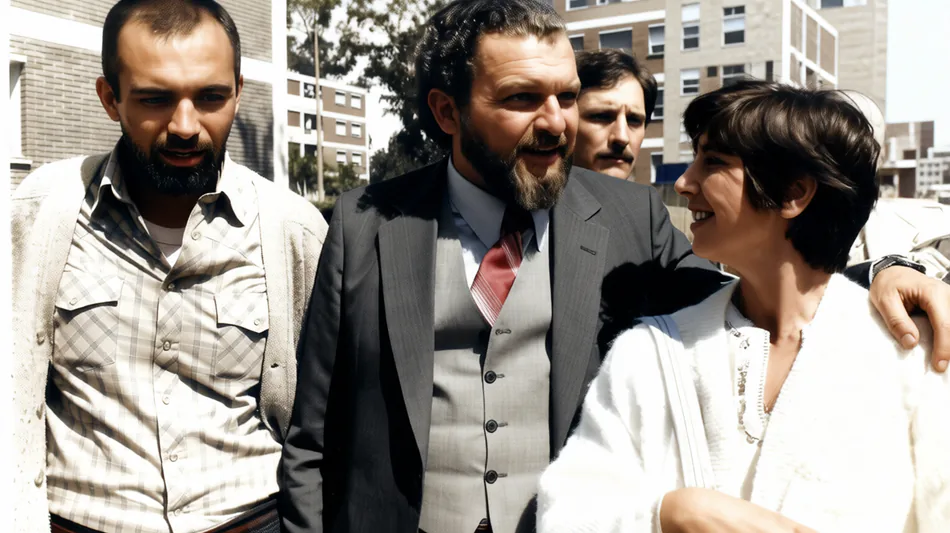
At 5 p.m. the following day, the doorbell rang. Lilián opened the door to two men: Brazilian journalist Luiz Claudio Cunha and photographer João Baptista Scalco. They had been alerted by an anonymous Spanish-speaking caller, identified later as PVP leader Hugo Cores in São Paulo, who provided the family’s address.
Celiberti later described the moment in her 2008 book, *Operation Condor: The Kidnapping of the Uruguayans*. “The nervous dance of her eyes left me certain that she was shaking, scared,” Cunha wrote. As he spoke to her, she moved aside, and both men found themselves facing the barrel of a gun.
They were escorted inside by officers who initially mistook them for fellow dissidents. Forced at pistol point against a wall, they were frisked. The lead officer’s expression shifted from disappointment to horror as he realized they were journalists from *Veja* magazine, an influential Brazilian weekly. After a tense interval during which the officer left the room to contact superiors, Cunha and Scalco were allowed to leave. Their legs were so weak from fear that the photographer could barely drive.
For the Brazilian security forces, the incident was a disaster. They had been exposed with a terrified Uruguayan dissident at a time when the government was publicly easing repression. Complicating matters, Scalco recognized one of the police officers as a former footballer.
The exposure prompted Cunha and Scalco to investigate tirelessly. Over 86 weeks, they published a series of stories about Celiberti’s disappearance in *Veja*. While the coverage did not secure her immediate release, both Celiberti and the journalists believe it prevented her enforced disappearance.
Celiberti was returned to Uruguay that night. She spent the next five years in prison, while her family faced retaliation for her protests. It was not until January of the following year that she received confirmation that her children were safe with her parents.
In prison, Celiberti convinced herself that her children’s safety was linked to her own visibility. In Punta de Rieles women’s prison, where she spent nearly two years in solitary confinement after a kangaroo court conviction, rank-and-file soldiers could see her through the bars. She noted that these were poor young men from the interior who viewed her with a mix of love and admiration, rather than as diehard supporters of the dictatorship.
Celiberti was sentenced to five years for violating the constitution, bringing arms into the country, and abandoning her children. She signed the false conviction cynically. “I thought, if everything here is false and we don’t recognize the military’s justice, I might as well sign it anyway,” she said.
Her time in solitary confinement, which she called “the dungeon,” involved no walks, visits, or activities. It was intended as subjugation but became a battle of wills. Inmates developed a system of knocks to communicate through walls, discussing international politics. One inmate asked about Iran’s Ayatollah Khomeini; Celiberti warned her he was a religious fundamentalist. They also discussed the role of the United States in supporting Southern Cone dictatorships and noted that President Jimmy Carter’s human rights agenda had curbed some abuses in Brazil.
Celiberti was released on November 21, 1983. She arrived at her parents’ home to find nearly 50 Brazilian journalists waiting for her. She spent the first three days between interviews and family reunions with little sleep.
Uruguay returned to democracy on March 1, 1985, under President Julio María Sanguinetti. Celiberti and Universindo had filed the first-ever lawsuit in Uruguay for dictatorship crimes regarding their kidnapping in 1984. However, in 1986, the government passed an amnesty law shielding security forces from prosecution.
Decades later, justice began to materialize. In 2022, two former Uruguayan military intelligence officers were prosecuted for their roles in the kidnapping. Two officers were convicted by a first-instance criminal court in 2025, with the sentence upheld on appeal in 2026. A third officer, Eduardo Ferro, was indicted in 2024, while a fourth remains a fugitive.
Celiberti argues that the Uruguayan state maintains an uncomfortably close relationship with the armed forces, hindering society’s ability to learn the truth about dictatorship crimes. She emphasizes that forensic scientists continue to search for the bodies of the disappeared on land still owned by the military. Sometimes, remains reveal that officials lied about causes of death.
“It’s a lie that feeds on itself and continues until today,” Celiberti said.
The files were co-produced with the Plancondor.org project, coordinated by Dr. Francesca Lessa in collaboration with Project Sitios de Memoria Uruguay, the Observatorio Luz Ibarburu of Uruguay, and Chile’s Londres38, with support from University College London.
J.Manu--HStB