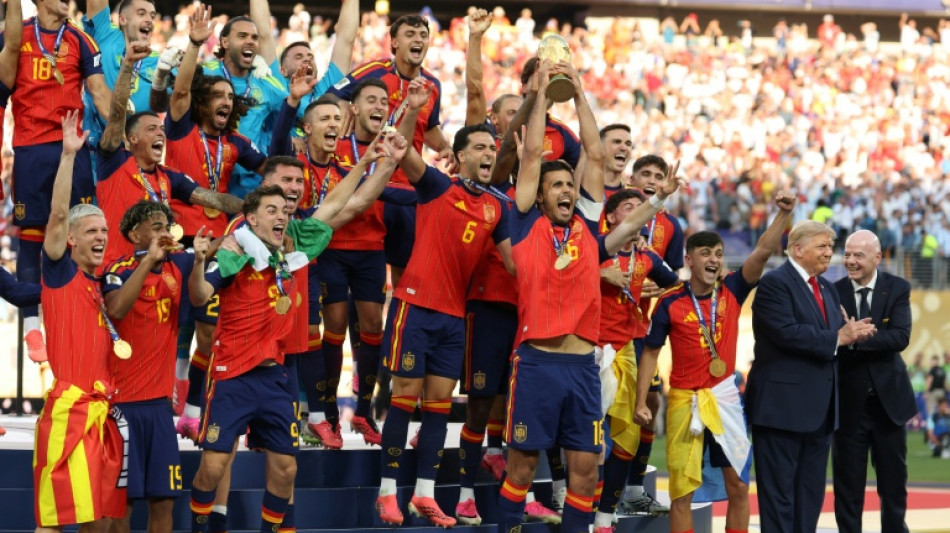
Infantino faces nervy times to see if challenger emerges / Photo: Odd ANDERSEN - AFP

Gianni Infantino's iron grip on the FIFA presidency has been significantly weakened by the global uproar over a now-abandoned plan to secure private investment in the World Cup and other flagship competitions.
The criticism and calls for Infantino's resignation have grown despite FIFA withdrawing the proposal just four days after announcing it.
The 56-year-old Swiss lawyer had looked set for a fourth and final term taking him up to 2031, as he was due to be unopposed in next March's election in Rabat.
The question is whether the opposition can rally round one candidate with the deadline for nominations November 18.
The name most frequently mentioned as a potential challenger or successor is Victor Montagliani, president of CONCACAF, which governs football in North and Central America and the Caribbean.
An emboldened opposition could also move sooner than that and call for an emergency meeting of the FIFA Council.
That would require the backing of 19 of the 37 members of the FIFA Council, triggering a meeting that must be held within two weeks.
In theory, the opposition has the numbers to force such a meeting, as the three confederations who were scathing of Infantino's leadership control 21 seats on the council.
European football's governing body UEFA has nine members, the Asian Football Confederation (AFC) has seven, while CONCACAF boasts five.
There is another more radical option, but one that is conceivable given the backlash: a no-confidence vote in Infantino.
An extraordinary FIFA congress can be held if 20 percent of the 211 members associations formally request it in writing.
It would take the support of just 43 member associations to spark such a move, a threshold that could easily be assembled from UEFA (55 members), CONCACAF (35) and AFC (46).
For the moment, just Wales, Finland, Sweden and Serbia have publicly withdrawn their support from Infantino.
Morocco, co-hosts of the 2030 World Cup, are one of the few to voice their support for the president.
Should it come down to a leadership contest, Montagliani appears the obvious challenger as a non-European candidate. Europe has held the post since Sepp Blatter was elected in 1998.
UEFA president Aleksander Ceferin and Norway's football chief Lise Klaveness -- who would be the first woman elected as president -- have both ruled themselves out in the past.
Victor Montagliani
The Canadian has been president of CONCACAF since 2016, bringing much needed stability to the confederation after his two immediate predecessors were swept up in the FIFA corruption scandal.
Montagliani, a FIFA vice-president long regarded as a close ally of Infantino, has distanced himself over the FIFA Forward Enterprise (FFE) plan. CONCACAF unanimously rejected the project and demanded "a comprehensive reckoning with this presidency".
Montagliani, who has worked as a flight attendant and then went into insurance, is so highly regarded in Vancouver he has had the day of his birth, September 12, named in his honour.
The multilingual 60-year-old can bask in the glory of a highly successful World Cup co-hosted by his native Canada, the US and Mexico.
However, there has been one controversy -- Canada Soccer's handling of Bob Birarda, who was head of the Vancouver Whitecaps women's programme and coach of the Canada women's under-20 team.
He left shortly before the 2008 Under-20 World Cup but continued coaching girls' teams. He was later jailed for sexual assault.
Montagliani was a vice-president of the Canadian association at the time and rejects claims the allegations against Birarda were swept under the carpet.
However, the 2022 McLaren Report, commissioned by Canada Soccer to conduct a review into the affair, was less than laudatory.
"Canada Soccer's failure to terminate Birarda afforded him the opportunity to continue... putting other players at potential risk," it said.
Nevertheless, Montagliani is seen as dynamic and collegiate. If he does enter the race, he is likely to run with the same unflinching determination displayed during his CONCACAF election campaign.
"Like anything, when I decide to go, I go," he told the British Columbia Business website.
"I campaigned on my own dime for three months, went to see all 41 countries, from the US to Bonaire, a little island off Venezuela."
C.Kalama--HStB