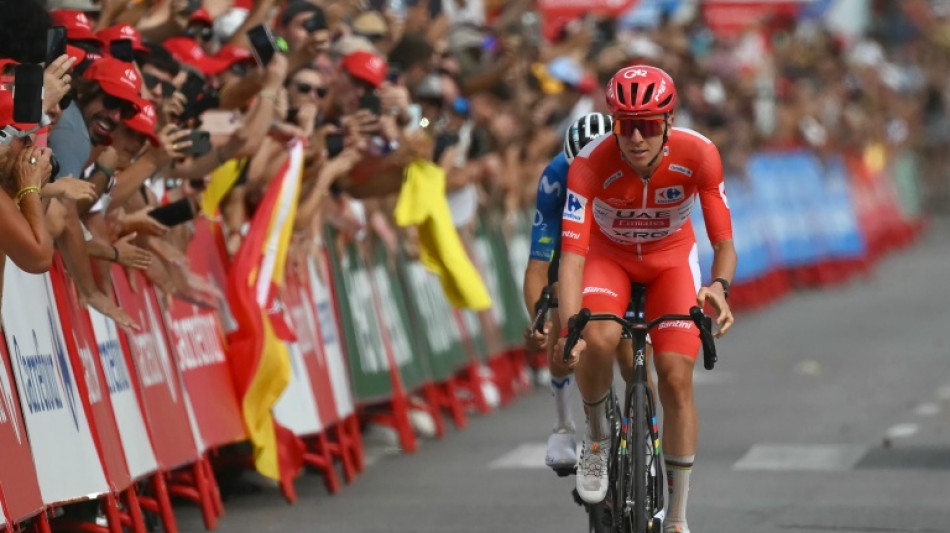
Pogacar 'happy to be alive' after difficult Vuelta crash recovery / Photo: JOSE JORDAN - AFP


Tadej Pogacar has revealed he suffered three fractured vertebrae in the crash that ended his season, admitting he is "just happy to be alive" after scans uncovered the full extent of injuries that also left him battling concussion-related balance problems.
The Slovenian rider had initially been diagnosed with a fracture in his neck and a broken collarbone following his Vuelta a Espana accident, but a follow-up scan in his home country uncovered further damage.
"There's actually a funny story. Two weeks ago, I was in Slovenia and I went to do another CT scan. I knew I had a C7 fracture, but then we saw I had two more broken vertebrae, the T1 and T2," Pogacar told The Athletic in an interview published Saturday.
"At that moment, I was happy I didn't do the European Championships, which had been my initial goal. When I saw I had three broken vertebrae? I'm just happy to be alive, actually, or just to be standing."
The five-time Tour de France champion said he has now returned largely to normal life, although he remains cautious as he continues to heal.
"I don't have discomfort anymore," he said. "I have to be careful not to crash on the bike, or do some heavy lifting with my left arm or with my neck. But I can do basically everything normal now."
Pogacar said the first weeks after the accident were particularly difficult. A concussion left him struggling with dizziness, nausea and poor coordination, preventing him from resuming normal activities.
"I had to be showered with the help of the team doctor. I could not shower. I was getting dizzy as soon as I stood or when I put my head down. I was just completely out of it and it was so tough," he said.
- 'Really depressed' -
The 28-year-old underwent surgery but said recovery was slower and mentally tougher than he had expected.
"It took one hour and 40 minutes, a long time, and when I got out of anesthesia the doctor was trying to make some jokes, but I was not feeling it. I was really depressed after the surgery," said Pogacar.
"For the first two weeks, I was really mentally not OK. I was really down. I was not a fun person to be around."
Pogacar said his mood improved once he resumed rehabilitation and indoor training.
"When I started to get on the home trainer, to go to physio every day, then I started to feel better -- also in the head. But it was a day-to-day fight."
Although doctors classified the neck fracture as stable, Pogacar said its potential consequences remained sobering.
"But if I crash again on the bike now, it can be very problematic. Everybody says that I was lucky, and you're always lucky after a crash where you can walk away and you're fine.
"You see it's pretty serious and not to joke around. It's a bit scary, to be honest, to think about it."
K.Nohea--HStB