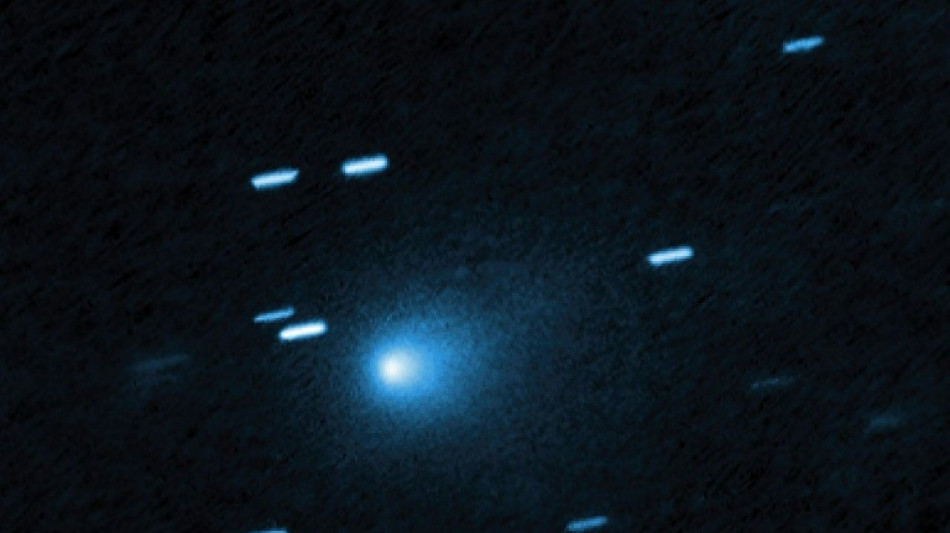
Interstellar comet likely far older than Solar System: astronomers / Photo: Handout, - - NASA/AFP/File



An interstellar comet that blazed past the Sun last year could be nearly three times older than our Solar System and is unlike anything ever before seen in our cosmic backyard, astronomers said Monday.
The comet 3I/ATLAS is just the third visitor from beyond our Solar System that humanity has ever observed, its unusual brightness offering scientists an unprecedented opportunity to study something that came from elsewhere in the galaxy.
After being spotted in July last year, the space rock prompted excitement online, with one prominent Harvard researcher speculating it could be an alien spacecraft -- a theory that NASA shot down.
Now, observations by the world's most powerful telescopes are revealing more about the unique comet.
According to a new study published in the journal Nature, 3I/ATLAS could be up to 12 million years old. Our Solar System is believed to have formed around 4.5 billion years ago.
Lead study author Martin Cordiner of NASA's Goddard Space Flight Center told AFP that "maybe it's the oldest object to have been observed in our Solar System".
However there could be "edge-case scenarios" that offer other explanations for the comet's unusual chemical composition, he added.
The new research is based on the comet's ratio of chemical elements called isotopes detected by the James Webb space telescope and the ALMA observatory in Chile.
These measurements "reveal an elemental composition unlike any Solar System body", the study said.
- Relic from 'cosmic noon'? -
Compared to comets in our Solar System, 3I/ATLAS has 10 times more deuterium, a type of hydrogen commonly seen in heavy water, according to the study.
"That high abundance of heavy water can only really happen, according to our understanding of astrochemistry, in a very cold environment," Cordiner explained.
This means the comet is also likely among the coldest objects ever seen in our Solar System, the isotopic evidence suggesting it formed in an environment that was minus 243 degrees Celsius.
Exactly where this comet came from within the Milky Way remains a mystery.
But these interstellar objects are thought to form in a similar way to the comets in our Solar System -- being flung out during the violent formation of a new planet.
Untethered to any star, 3I/ATLAS likely spent billions of years on "vast unimaginable trajectories around our galaxy," Cordiner said.
The scientists also detected a strange lack of chemical enrichment on the comet, which suggests it formed relatively close to stars being born.
It could even be a "relic" from an era called "cosmic noon" when many stars were forming around 10 billion years ago, Cordiner said.
The previous interstellar objects -- 1I/'Oumuamua, which was spotted in 2017, followed by 2I/Borisov in 2019 -- were not bright enough to gather isotopic evidence.
Harvard professor Avi Loeb, who had previously sparked controversy by suggesting 'Oumuamua could be an alien spacecraft, made similar suggestions about 3I/ATLAS.
However NASA has dismissed this possibility. The Search for Extraterrestrial Intelligence Institute (SETI) said last month it had found "no evidence of extraterrestrial technology" on the comet.
- 'Just the beginning' -
Several astronomers who have studied 3I/ATLAS, but were not involved in the new research, hailed the "unprecedented" results.
"Until these measurements we could only really dream about" getting this kind of information for an interstellar object, Darryl Seligman of Michigan State University told AFP.
He cautioned that the comet's age remained uncertain, adding it was "a safe bet that it's older than anything that formed in the Solar System".
Astronomer Peter Veres, who was involved in identifying the comet at the International Astronomical Union's Minor Planet Center, called the research "exciting".
"The comet is now leaving the Solar System and will never return, so future observations will become increasingly difficult," he told AFP.
However astronomers expect to spot many more interstellar objects in the coming years, particularly via the new Vera C. Rubin Observatory in Chile.
"This is just the beginning of an exciting new field, we've got a lot more to learn about these things -- and what they can tell us about our galaxy," Cordiner concluded.
L.Ohana--HStB