China Launches Shenzhou 24 With First Pakistani Astronaut to Tiangong Station



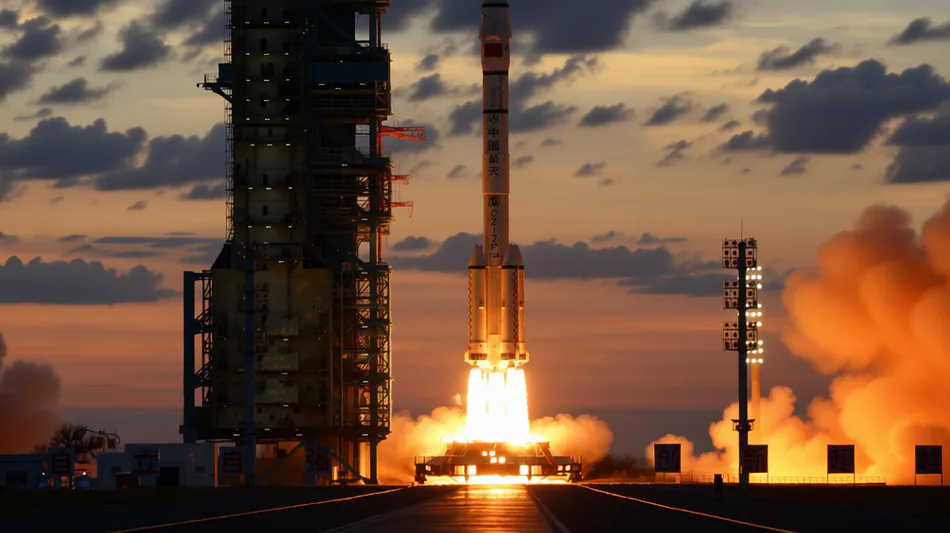
China has successfully launched its Shenzhou 24 spacecraft from the Jiuquan Satellite Launch Centre, carrying Pakistani astronaut Muhammad Zeeshan Ali on a historic mission to the Tiangong space station. The launch marks the first time the Chinese orbital outpost has hosted a foreign crew member, underscoring deepening space ties between Beijing and Islamabad.
China has successfully launched the Shenzhou 24 spacecraft, carrying Pakistani astronaut Muhammad Zeeshan Ali on a historic mission to its Tiangong space station. The launch from the Jiuquan Satellite Launch Centre in northwestern China marks the first time the Chinese orbital outpost has hosted a foreign crew member.
The China Manned Space Agency (CMSA) confirmed Wednesday morning that the launch was a "complete success." A Long March 2F rocket carried the spacecraft into orbit at 8:18 am Beijing Time (0:18 am GMT). Official broadcasts showed plumes of smoke erupting from the launchpad as the rocket ascended with significant force.
The spacecraft successfully separated from its booster and entered its predetermined trajectory. It is scheduled to dock with the Tiangong space station around 3:48 am GMT.
Aboard the Shenzhou 24 are three crew members: Ali, 40; Tang Hongbo, 51; and Wu Yi, 39. The mission represents a significant milestone for Beijing’s crewed space program and reflects the strengthening diplomatic and technical ties between China and Pakistan.
Pakistani Prime Minister Shehbaz Sharif sent his best wishes to the astronauts prior to the launch. In a post on the social media platform X, Sharif wrote that "Pakistan-China friendship is surpassing the heights of the Himalayas in its journey to outer space."
Once docked, the crew will conduct more than 90 scientific experiments and technology tests. According to Chinese state broadcaster CCTV, Ali’s specific responsibilities include research in biotechnology and materials science, focusing on photosynthetic microorganisms. He is expected to return to Earth approximately one week later aboard the Shenzhou 23 spacecraft.
Ali has undergone intensive training for seven months since his selection for the mission in April. He previously told reporters that mastering advanced Mandarin was his greatest challenge, necessary for communicating with his crewmates and operating complex machinery labeled in Chinese.
"I’m not flying for myself; I carry the name of Pakistan on my shoulder, the hope of 250 million Pakistanis," Ali said earlier in the week. He added a message to young viewers: "To every child who’s watching while I’m in orbit, look up at the sky and remember that I am up there with your dreams."
The joint mission is part of an agreement signed by China and Pakistan in February 2025. Ali expressed hope that this cooperation would expand from a single astronaut on one flight to multiple joint missions, potentially extending to lunar and Martian exploration.
China’s Tiangong space station, completed in late 2022, maintains a constant presence in orbit with rotating crews serving six-month missions. Beijing has announced plans to double the size of the station in the coming years and facilitate more international joint missions.
This development occurs amid intense rivalry between China and the United States in space exploration. Both nations aim to land astronauts on the lunar surface by 2030. China’s decision to develop its own independent space station rather than participate in the International Space Station reflects this competitive landscape.
E.Kaleo--HStB